

Markets & Regions
Hong Kong and Latin America: New Trade Agreements and a Bridge to Asian Markets
With the Hong Kong–Peru free trade agreement in force since September 2026 and an established agreement with Chile, Hong Kong is building ties with Latin America. What it means for exporters and importers on both sides.

Latin America and Asia sit on opposite sides of the Pacific, but their economies are increasingly intertwined. Copper, lithium, iron ore, soybeans, fruit, seafood and coffee flow west across the ocean. Machinery, electronics, vehicles and consumer goods flow back. China has become the largest trading partner for several South American economies.
Hong Kong has been part of this trade for decades, mostly behind the scenes. Its formal ties with the region are now catching up.
Agreements in place
Free trade agreements
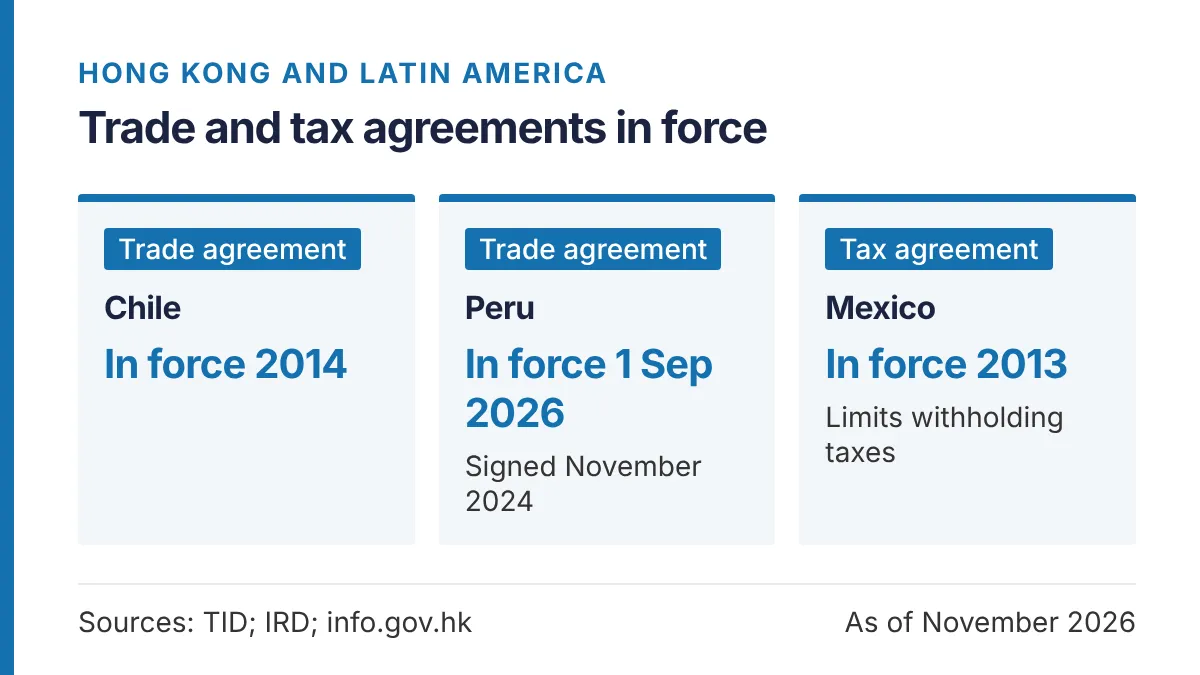
- Chile. Hong Kong's free trade agreement with Chile has been in force since 2014.
- Peru. Signed in November 2024, the Hong Kong–Peru free trade agreement entered into force on 1 September 2026. It covers trade in goods and services, and the Hong Kong government has highlighted market access for Hong Kong service providers across a wide range of sectors.
Hong Kong itself charges no tariffs on imports, so the main benefit of these agreements for Hong Kong-based exporters is better access to Chilean and Peruvian markets, along with commitments on services and investment.
Tax agreements
Hong Kong has a comprehensive double tax agreement with Mexico, in force since March 2013. It limits withholding taxes on cross-border dividends, interest and royalties and clarifies when business profits can be taxed in each place. As of November 2026, Chile has a free trade agreement with Hong Kong but no comprehensive double tax agreement.
Why Hong Kong matters to Latin American business
Contracting with Asian counterparties
Asian buyers and suppliers are comfortable contracting with Hong Kong companies, under Hong Kong law, with disputes resolved by arbitration in Hong Kong. For a Peruvian fruit exporter selling to buyers across Asia, or a Mexican manufacturer buying components from China, that familiarity smooths negotiations.
Banking in the currencies of trade
Most Latin America–Asia trade is priced in US dollars, and a growing share of trade with China is settled in renminbi. Hong Kong banks handle both routinely, alongside Hong Kong dollars and other major currencies.
Trade finance
Letters of credit, documentary collections and supply-chain finance are standard in Hong Kong. For commodity exporters dealing with long shipping times across the Pacific, access to finance against shipments can make a significant difference to working capital.
A time zone bridge
Hong Kong is 11 to 14 hours ahead of most of Latin America. That sounds inconvenient, but it means a Hong Kong-based team or service provider can process payments and documents overnight, ready for the start of the Latin American working day.
The friction points
Two issues come up repeatedly:
- Currency conversion. Converting soles, pesos or reais to US dollars, then to renminbi, then back again, adds spreads at each step. Some countries in the region also apply foreign exchange controls.
- Payment speed. Transfers between Latin American and Asian banks often route through US correspondent banks, adding time and cost.
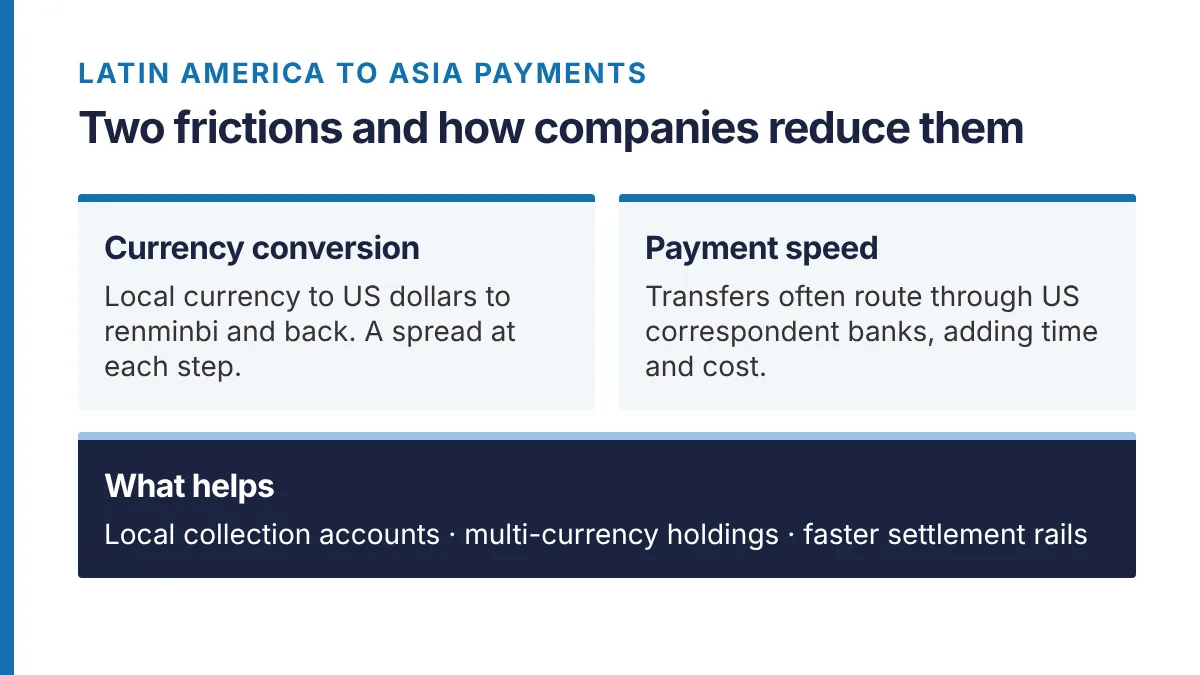
Companies that solve these two problems, through local collection accounts, multi-currency holdings and faster settlement rails, tend to see the biggest gains from an Asian hub. Our cross-border payments service focuses on exactly these corridors.
Who benefits most
- Commodity and food exporters selling into several Asian markets.
- Importers and manufacturers buying machinery and components from Asia, including those involved in nearshoring production to Mexico.
- Asian companies investing in Latin American resources, infrastructure and consumer markets.
- Service firms working on both sides of the Pacific.
We look at the practical set-up in our guide for Latin American exporters using a Hong Kong company.
Frequently asked questions
When did the Hong Kong–Peru FTA take effect?
The agreement, signed in November 2024, entered into force on 1 September 2026.
Which Latin American countries have trade or tax agreements with Hong Kong?
Hong Kong has free trade agreements with Chile and Peru, and a comprehensive double tax agreement with Mexico, among its wider network.
Why would a Latin American business use Hong Kong?
To contract with Asian buyers and suppliers, bank in US dollars and renminbi, access trade finance and use common law contracts and arbitration that Asian counterparties accept.
Sources
This article is general information, not legal or tax advice. Rules and figures can change; confirm details for your situation before acting.