
Setting Up
A Hong Kong Company for Latin American Exporters and Importers: How It Works
How exporters and importers in Peru, Chile, Mexico, Colombia and Brazil structure a Hong Kong company for Asian trade, handle multiple currencies, and plan for home-country tax rules.

A Chilean cherry exporter shipping to buyers in Asia during the peak season. A Peruvian mining services firm working with Asian clients. A Mexican manufacturer buying electronic components from Shenzhen and Taipei. Each faces the same practical questions: how to contract with Asian counterparties, how to get paid and pay suppliers efficiently, and how to do it without falling foul of rules at home.
A Hong Kong company is one well-tested answer.
Typical structures
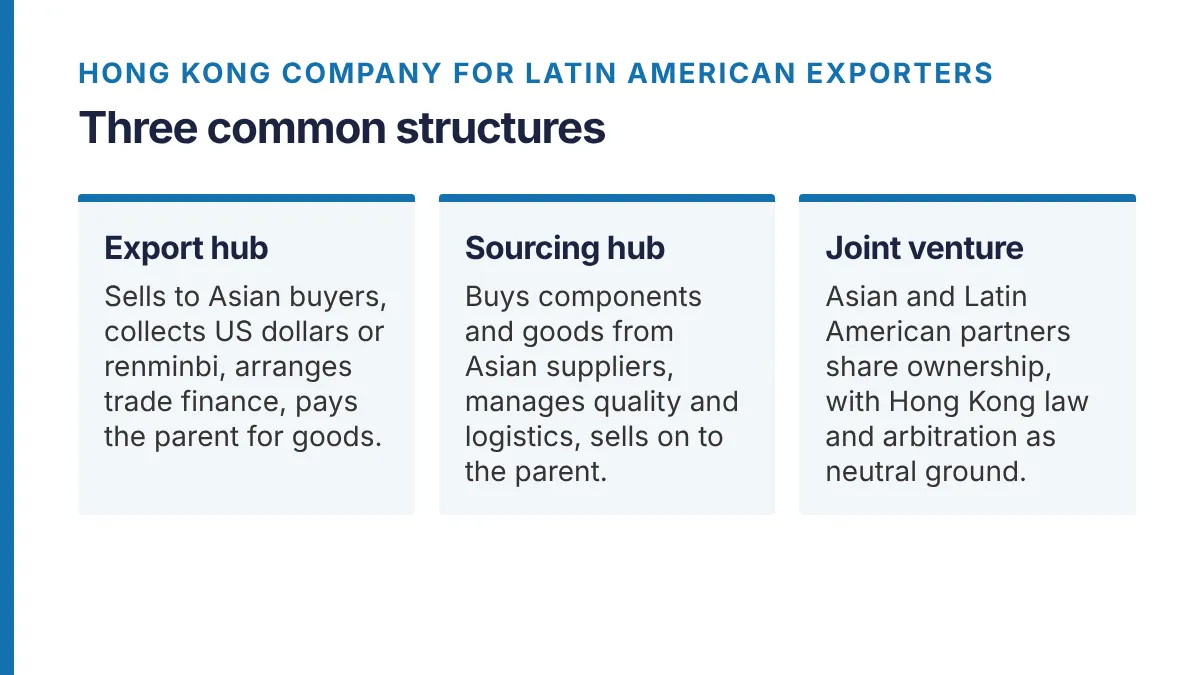
The export hub
A Latin American exporter forms a Hong Kong subsidiary that sells to Asian buyers. The Hong Kong company contracts with buyers, collects payment in US dollars or renminbi, arranges trade finance against shipments, and pays the parent for the goods.
The sourcing hub
A Latin American manufacturer or distributor forms a Hong Kong company that buys components, machinery or finished goods from Asian suppliers, manages quality control and logistics, and sells on to the parent.
The joint venture
An Asian investor and a Latin American partner jointly own a Hong Kong company that holds their shared investment, using Hong Kong law and arbitration as neutral ground.
What you need to set up
- One director and one shareholder, of any nationality.
- A Hong Kong company secretary and registered office, which we provide as part of incorporation.
- Passports and proof of address for directors and major shareholders.
- Registration documents for any company in the ownership chain.
- Evidence of the trade: buyer or supplier contracts, past export or import records, a description of how goods move.
The company can be incorporated in about a week. The bank account typically takes a few weeks longer; see our guide to opening an account as a non-resident.
Plan the home-country side first
This is the step that matters most for Latin American founders. Several countries in the region have rules designed for exactly this kind of structure:
- Mexico applies rules to income of foreign entities taxed at less than 75% of the Mexican corporate rate. Hong Kong's 16.5% rate is below that threshold, so profits of a Hong Kong subsidiary may be taxed currently in Mexico.
- Brazil has historically included Hong Kong on its list of favourable tax jurisdictions, which affects withholding tax and transfer pricing on payments between Brazil and a Hong Kong company.
- Most countries apply transfer pricing rules to transactions with related foreign companies, requiring arm's-length prices and documentation.
- Some countries apply foreign exchange controls or reporting requirements on holding funds abroad.
None of this rules out a Hong Kong company. It means the structure must have genuine commercial reasons, such as Asian customers, suppliers, finance or staff, and must be documented properly at both ends. Speak to a local tax adviser before setting up; we work alongside them on the Hong Kong side.
Currency and payments: where the real savings are
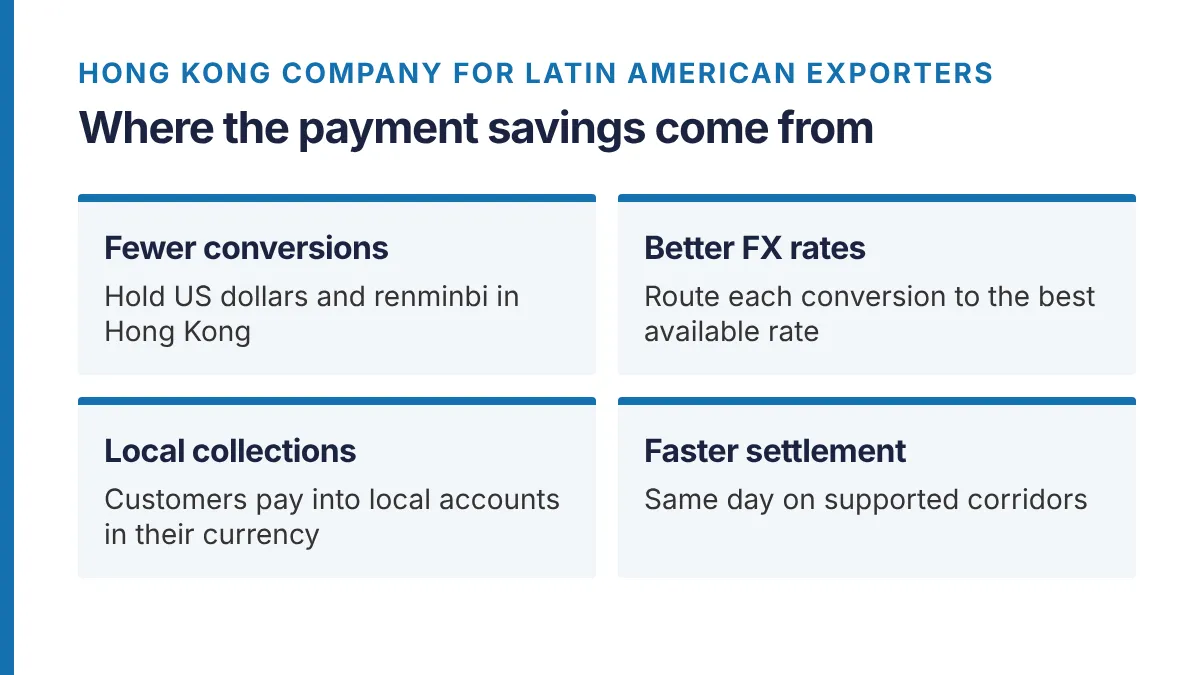
For most Latin American trading businesses, the measurable gains from a Hong Kong company come from payments rather than tax:
- Fewer conversions. Holding US dollars and renminbi in Hong Kong avoids converting to and from local currency on every transaction.
- Better FX rates. Conversions can be routed to the best available rate rather than a single bank's spread.
- Local collections. Where available, customers and partners can pay into local accounts in their own currency.
- Faster settlement. On supported corridors, combining bank transfers with regulated stablecoin settlement can cut settlement from days to the same day.
Our cross-border payments service brings these together, with compliance checks at every step.
Using the trade agreements
If you export from Chile or Peru, check whether the Hong Kong free trade agreements give your goods or services better treatment, and keep certificates of origin in order. If you trade with Mexico, the double tax agreement with Hong Kong can reduce withholding taxes on dividends, interest and royalties, provided the Hong Kong company obtains a Certificate of Resident Status.
Keep the Hong Kong company in good standing
Every Hong Kong company needs annual audited accounts, a profits tax return and an annual return. Those audited accounts also help with home-country transfer pricing documentation and bank reviews. Our accounting and company secretary services keep everything on schedule remotely.
Frequently asked questions
Can a Peruvian, Chilean or Mexican company own a Hong Kong company?
Yes. There are no nationality restrictions on shareholders or directors, and the company can be set up remotely.
How do Latin American tax rules treat a Hong Kong subsidiary?
It varies. Mexico has rules for income taxed at less than 75% of the Mexican rate, and Brazil has historically listed Hong Kong as a favourable tax jurisdiction. Take local tax advice before setting up.
Which currencies should the Hong Kong company use?
Most Latin America–Asia trade is priced in US dollars, with renminbi increasingly used for trade with China. A Hong Kong company can hold both, alongside Hong Kong dollars.
Sources
This article is general information, not legal or tax advice. Rules and figures can change; confirm details for your situation before acting.