

Banking & Payments
Hong Kong's Stablecoin Regime: What the First Licences Mean for Cross-Border Business
Hong Kong's Stablecoins Ordinance took effect in August 2025 and the first issuer licences were granted in April 2026. A plain-English look at what is regulated, who can issue, and how ordinary companies may use it.

Stablecoins have moved from the fringes of crypto to the agendas of central banks. A stablecoin is a digital token designed to hold a stable value, usually by being backed one-to-one with a currency such as the US dollar or Hong Kong dollar. Because it moves on a blockchain, it can be transferred between parties in minutes, at any hour.
Several jurisdictions have now created rules for stablecoins. Hong Kong was among the first in Asia to put a full licensing regime in place, and in April 2026 it granted its first licences.
The legal framework
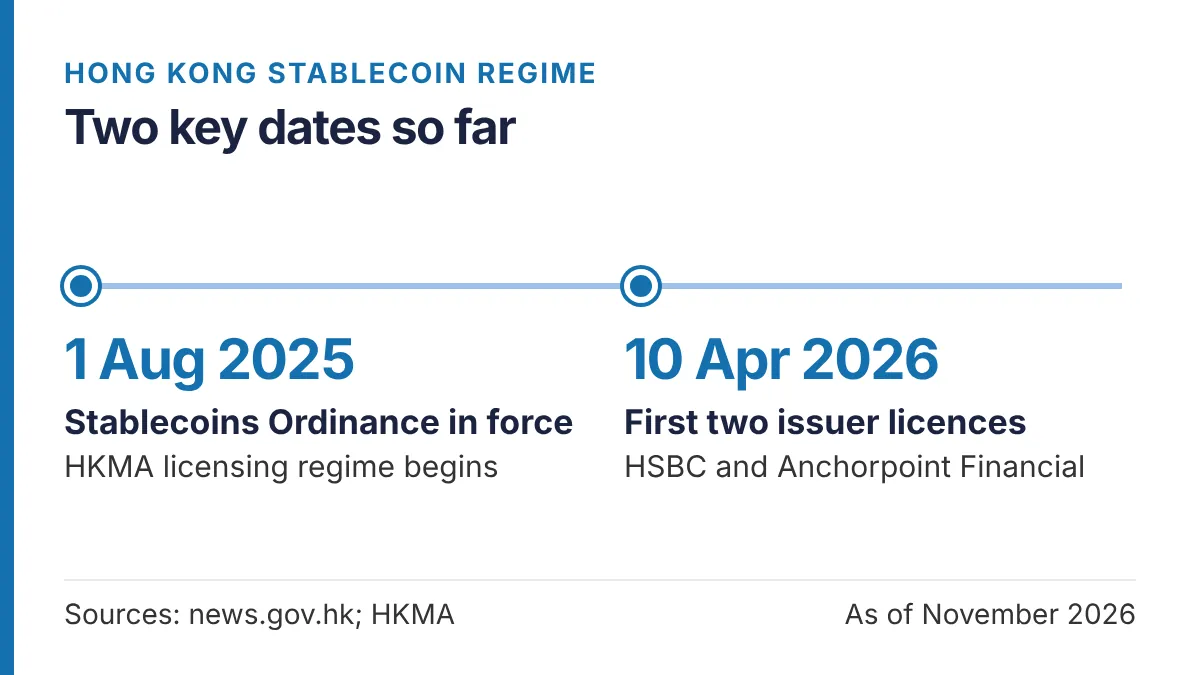
Hong Kong's Stablecoins Ordinance came into operation on 1 August 2025. It is administered by the Hong Kong Monetary Authority (HKMA), the city's de facto central bank.
In broad terms, the regime:
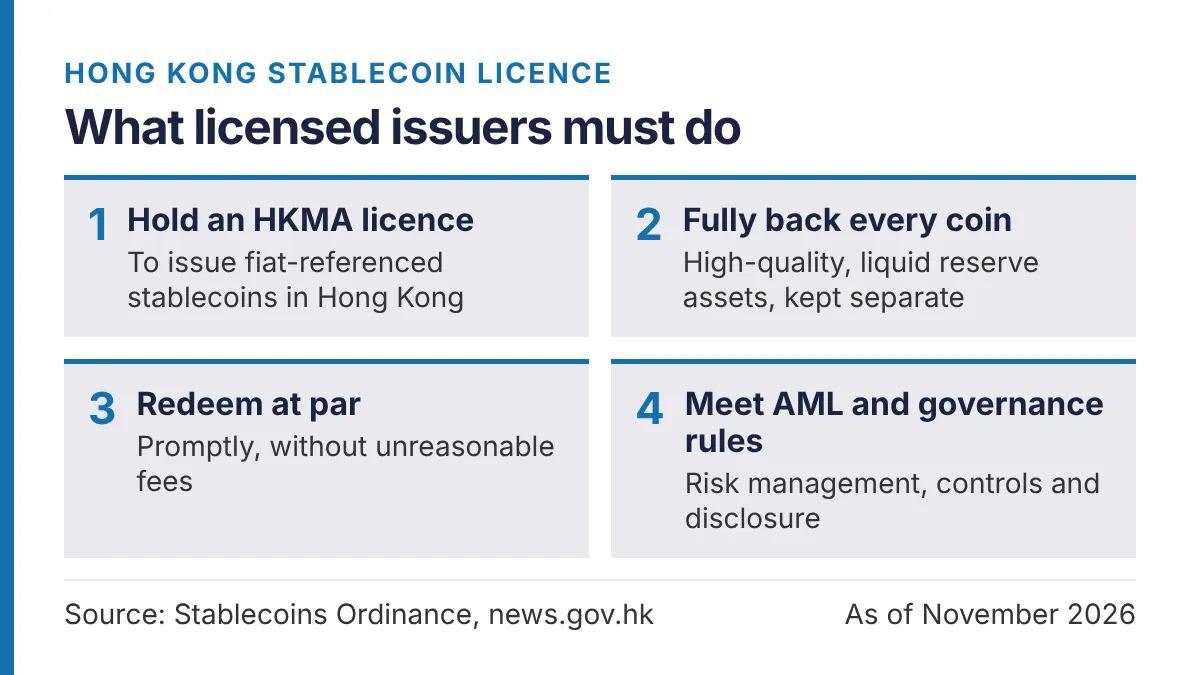
- Requires a licence to issue fiat-referenced stablecoins in Hong Kong, or to issue stablecoins that reference the value of the Hong Kong dollar.
- Requires licensed issuers to hold full reserve backing in high-quality, liquid assets, kept separate from the issuer's own assets.
- Requires issuers to redeem stablecoins at par for holders, promptly and without unreasonable fees.
- Imposes requirements on governance, risk management, anti-money laundering controls and disclosure.
- Restricts who may offer stablecoins to the public in Hong Kong.
The first licences
On 10 April 2026, the HKMA granted the first two stablecoin issuer licences, taking immediate effect:
- The Hongkong and Shanghai Banking Corporation (HSBC).
- Anchorpoint Financial, a joint venture of Standard Chartered Bank (Hong Kong), HKT and Animoca Brands.
The choice of licensees is telling. Two of Hong Kong's note-issuing banks are behind the first licences, which signals that regulated stablecoins in Hong Kong are being built inside the existing financial system, not outside it.
Why it matters for international business
For most companies, a stablecoin is not an investment. It is a payment instrument. Its value lies in what it can do for settlement:
- Speed. Transfers settle in minutes rather than days, including weekends and public holidays.
- Fewer intermediaries. A payment does not need to pass through a chain of correspondent banks.
- Predictable cost. Fees do not stack up at each intermediary.
- Programmability. Payments can be linked to invoices, delivery milestones or escrow conditions.
These advantages matter most on corridors where traditional banking is slow or expensive, which often means payments involving Africa, parts of the Middle East, Latin America and South Asia.
What a regulated regime adds
Stablecoins existed before Hong Kong's law. What the regime adds is trust:
- Holders know the issuer is licensed and supervised.
- Reserves are required to be held in high-quality assets and segregated.
- Redemption at par is a legal obligation, not a marketing promise.
- Anti-money laundering standards apply, which matters to banks and auditors.
For a finance team, that difference is decisive. A company can explain to its auditor, its bank and its board that it settles certain payments using a supervised instrument, rather than an unregulated token.
Practical considerations
Using stablecoins in a business still requires care:
- Know-your-customer and sanctions checks apply to stablecoin flows just as they do to bank transfers.
- Accounting treatment should be agreed with your auditor in advance.
- On- and off-ramps matter. The benefit depends on converting efficiently between stablecoins and local currency at each end.
- Not every stablecoin is equal. Unlicensed or unbacked tokens carry very different risks from those issued under a regulated regime.
- Counterparties must be ready. A supplier who cannot receive or convert stablecoins will still need a bank transfer.
This is why most businesses use stablecoins as one rail among several, not as a replacement for banking. A dual-rail approach, choosing bank transfer or stablecoin settlement payment by payment, captures the speed where it helps without forcing every counterparty to change. That is the model behind our cross-border payments service.
What to watch next
Expect more issuer licences, clearer guidance on how licensed stablecoins can be used by businesses, and closer links between stablecoin settlement and traditional bank accounts. Hong Kong's broader digital asset framework, including licensing for virtual asset trading platforms, continues to develop alongside it.
Frequently asked questions
When did Hong Kong's stablecoin law take effect?
The Stablecoins Ordinance came into operation on 1 August 2025.
Who received the first stablecoin licences in Hong Kong?
On 10 April 2026, the HKMA granted the first issuer licences to The Hongkong and Shanghai Banking Corporation (HSBC) and to Anchorpoint Financial, a joint venture of Standard Chartered Bank (Hong Kong), HKT and Animoca Brands.
Can an ordinary company use stablecoins for payments?
Companies can use regulated stablecoins to settle payments where their banks, payment providers and counterparties support it, subject to know-your-customer, anti-money laundering and accounting requirements.
Sources
This article is general information, not legal or tax advice. Rules and figures can change; confirm details for your situation before acting.


