

Banking & Payments
How to Reduce the Cost of Cross-Border Payments to Emerging Markets
Where the money actually goes when you pay a supplier or collect from a customer in Africa, the Middle East or Latin America, and seven practical ways to cut fees, FX spreads and settlement time.

Most finance teams know what they pay their bank per international transfer. Far fewer know the true cost of a payment from start to finish. On corridors into and out of emerging markets, the difference between the two can be large.
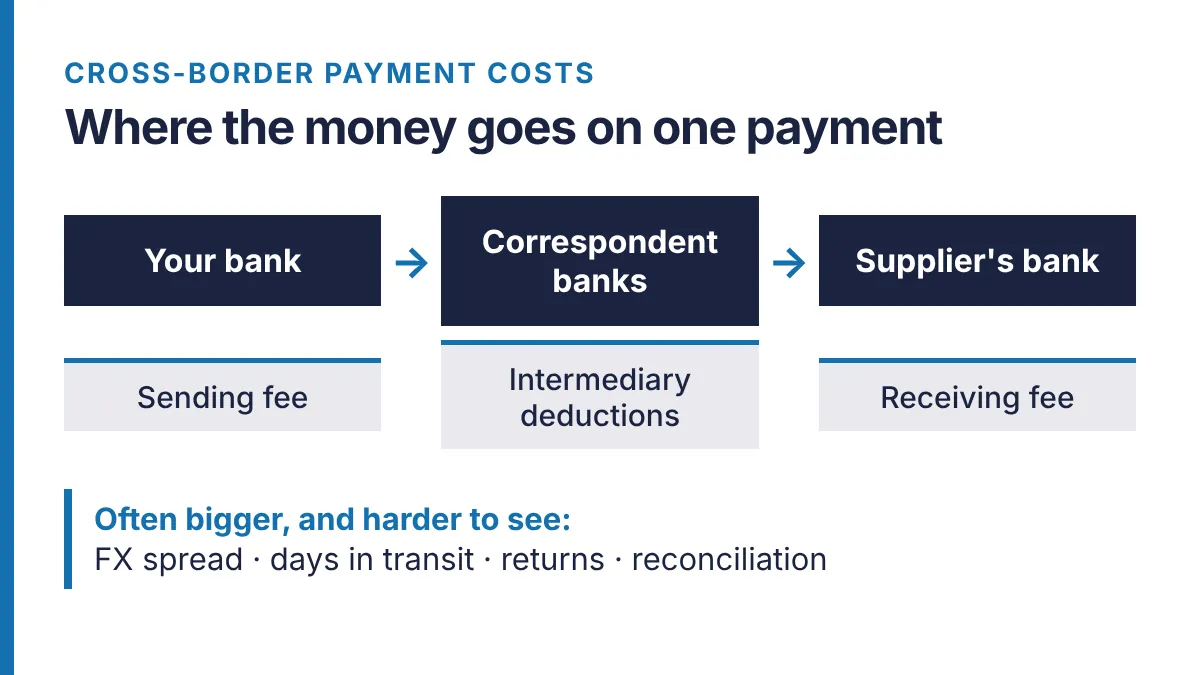
Where the money actually goes
A single payment from a Hong Kong company to a supplier in Lagos, or from a customer in Lima to a company in Hong Kong, can carry several layers of cost:
| Cost | How it appears |
|---|---|
| Sending fee | A fixed charge from your bank |
| Intermediary deductions | Correspondent banks deduct fees, so less arrives than was sent |
| Receiving fee | The beneficiary's bank charges on arrival |
| FX spread | The rate you receive is worse than the mid-market rate, sometimes by several percent |
| Time | Money in transit for days cannot be used, and suppliers may price in the delay |
| Failed and returned payments | Errors or compliance holds lead to repeat fees and delays |
| Reconciliation | Staff time matching partial, late payments to invoices |
On many emerging-market corridors, the FX spread and the cost of time together outweigh every fee on the bank's tariff.
Seven ways to cut the cost
1. Collect locally where you can
If customers can pay into a local account in their own currency, they avoid international transfer fees and you avoid intermediary deductions. Local collection accounts, sometimes called virtual accounts, are available in a growing number of markets.
2. Hold the currencies you use
Converting every receipt into one base currency and converting back when paying suppliers means paying the spread twice. A multi-currency set-up lets you hold US dollars, renminbi and other currencies and pay out of the same currency you received where possible. Hong Kong corporate accounts make this routine.
3. Shop the FX rate
A single bank quote is rarely the best available. Routing conversions across several liquidity venues and taking the best rate can cut spread costs noticeably, especially on larger amounts or less traded currencies.
4. Reduce the number of hops
Each correspondent bank in a chain adds cost and delay. Payment providers with direct local partners, or with alternative rails, can cut the chain from several banks to one or two steps.
5. Use a second rail where it helps
On some corridors, regulated stablecoin settlement moves value in minutes, at any hour, with predictable fees. It is not right for every payment, and both sides need to convert efficiently to and from local currency. But as one rail alongside bank transfers, chosen payment by payment, it can turn a three-day settlement into a same-day one.
6. Batch and schedule
Many small payments cost more than fewer larger ones. Batching supplier payments, and scheduling them to avoid weekends and holidays on traditional rails, reduces both fees and the time money spends in transit.
7. Automate reconciliation
Partial and late payments create manual work. Automatic matching of incoming payments to invoices, with clear references and fee visibility, frees finance staff and catches problems early.
Compliance is not optional
Cheaper and faster only helps if payments are also compliant. Every legitimate provider applies know-your-business and know-your-customer checks, sanctions screening and transaction monitoring, and keeps client funds segregated. Payments to sanctioned or restricted jurisdictions are not supported anywhere in the regulated system. Choose providers who build these checks in, rather than ones who promise to avoid them.
Putting it together
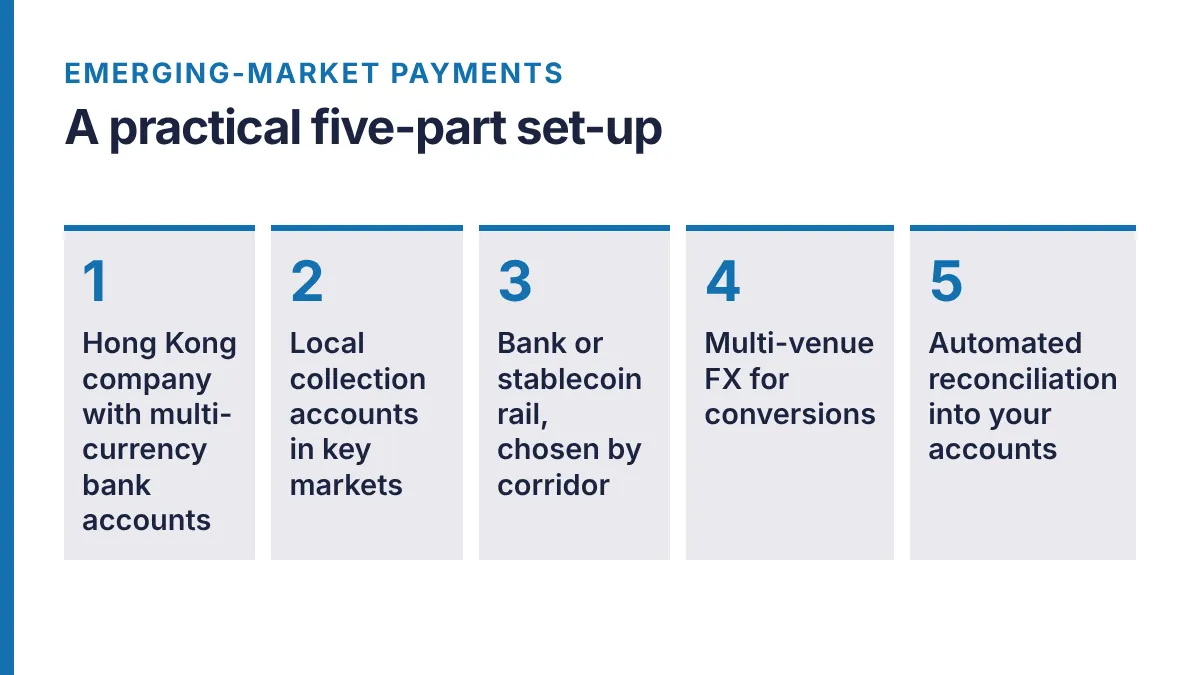
For a company trading between Asia and emerging markets, a practical set-up often looks like this:
- A Hong Kong company with multi-currency bank accounts as the hub.
- Local collection accounts in key customer markets.
- Dual-rail settlement, bank transfer or regulated stablecoin, chosen by corridor.
- Multi-venue FX for conversions.
- Automated reconciliation feeding the company's accounts.
This is the model behind our cross-border payments service: same-day settlement on key stablecoin corridors*, lower FX costs and full visibility, within a compliance-first framework.
*Settlement times and available regions depend on eligibility, corridor rules, partner coverage and compliance review.
Frequently asked questions
What is the biggest hidden cost in international payments?
Usually the foreign exchange spread, the difference between the rate you get and the mid-market rate, plus fees deducted by intermediary banks along the way.
How can I speed up payments to Africa or Latin America?
Use local collection and payout accounts where available, reduce the number of intermediary banks, and consider regulated stablecoin settlement on supported corridors.
Is stablecoin settlement compliant?
It can be, when it uses regulated stablecoins and providers that apply know-your-customer, anti-money laundering and sanctions checks. Hong Kong licenses stablecoin issuers under its Stablecoins Ordinance.
Sources
This article is general information, not legal or tax advice. Rules and figures can change; confirm details for your situation before acting.


