
Hong Kong's Global Position
Hong Kong and the Greater Bay Area: A Door to Southern China's Factories and Consumers
The Greater Bay Area links Hong Kong, Macao and nine cities in Guangdong into a region of more than 86 million people. How international companies use Hong Kong to reach its manufacturing base, technology hubs and consumers.

Within an hour or two of Hong Kong's financial district lie some of the most productive manufacturing regions on earth. Shenzhen builds a large share of the world's electronics. Dongguan and Foshan make furniture, machinery, textiles and components. Guangzhou is a trading and logistics centre in its own right.
Together with Hong Kong and Macao, these cities form the Guangdong–Hong Kong–Macao Greater Bay Area (GBA). For international companies, understanding how Hong Kong fits into it explains much of the city's role today.
What the Greater Bay Area is
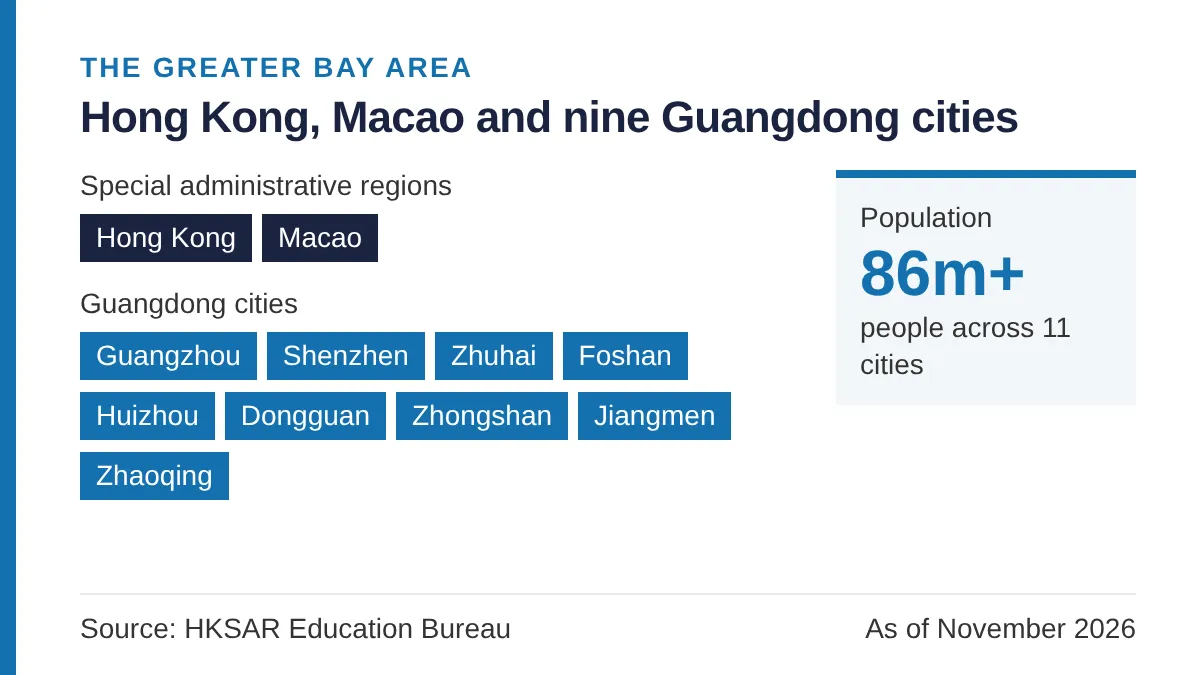
The GBA covers Hong Kong, Macao and nine cities in Guangdong province: Guangzhou, Shenzhen, Zhuhai, Foshan, Huizhou, Dongguan, Zhongshan, Jiangmen and Zhaoqing. Its population is more than 86 million, larger than most European countries, and it is one of the wealthiest and most industrialised regions in China.
A development plan published in 2019 set out the goal of integrating the region more closely: transport, finance, innovation and talent flows.
What each part brings
The region works because its parts are different:
| Part of the GBA | Typical strengths |
|---|---|
| Hong Kong | Finance, law, professional services, logistics, international connectivity |
| Shenzhen | Technology, electronics, hardware innovation, venture capital |
| Guangzhou | Trade fairs, logistics, automotive, commerce |
| Dongguan, Foshan, Zhongshan | Manufacturing, components, furniture, appliances |
| Macao | Tourism, links with Portuguese-speaking countries |
International companies rarely need all of it. Most use Hong Kong for contracting, banking and holding, and work with suppliers, partners or subsidiaries elsewhere in the region.
How Hong Kong connects the region to the world
Two systems, one region
Hong Kong keeps its own legal system, currency, customs territory and tax system. That means an international company can sign contracts under common law, hold funds in freely convertible currencies, and pay a simple profits tax, while working closely with suppliers a short drive away.
Preferential access
Under the Closer Economic Partnership Arrangement (CEPA), goods of Hong Kong origin that meet the rules of origin enter the mainland tariff-free, and Hong Kong service providers enjoy preferential access in many sectors.
Physical links
High-speed rail connects Hong Kong to Shenzhen, Guangzhou and the national network. The Hong Kong–Zhuhai–Macao Bridge links the western side of the delta. Multiple land crossings carry goods and people daily.
Financial links
The "Connect" schemes link Hong Kong's markets with the mainland's: Stock Connect and Bond Connect for investors, and Cross-boundary Wealth Management Connect for individuals in the GBA. Hong Kong is also widely regarded as the largest offshore renminbi centre.
How international companies use it
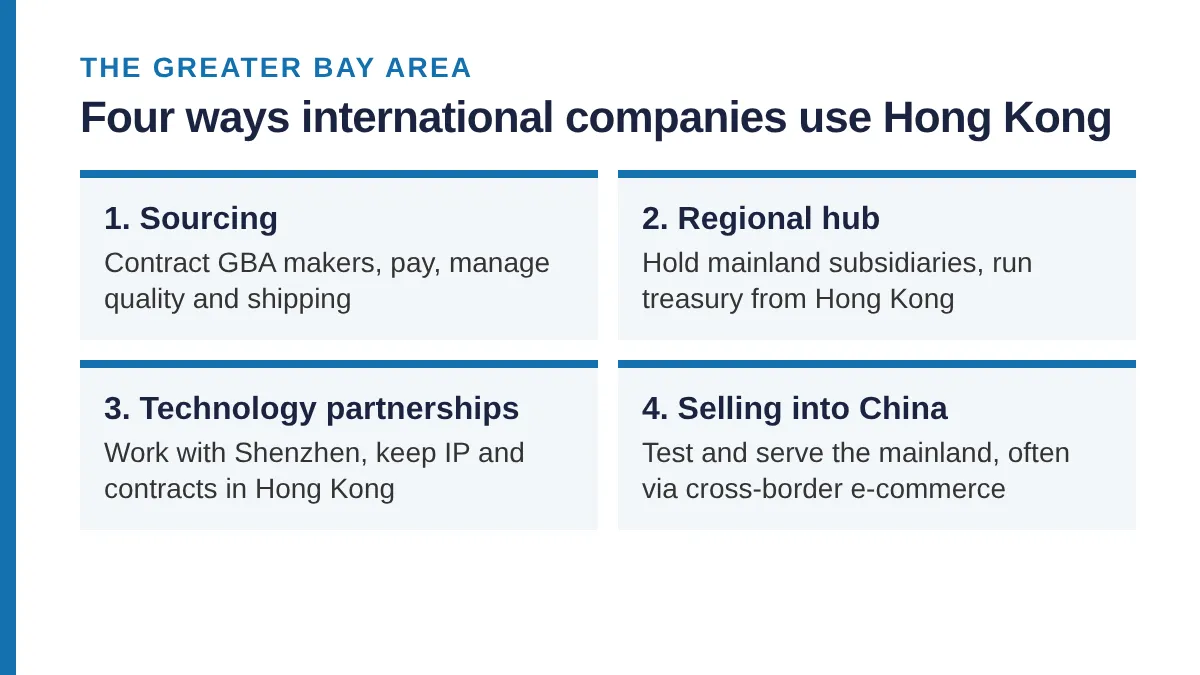
- Sourcing. A Hong Kong company contracts with GBA manufacturers, pays in renminbi or US dollars, and manages quality and shipping.
- Regional hub. A Hong Kong company holds mainland subsidiaries or joint ventures, with financing and treasury run from Hong Kong.
- Technology partnerships. Hardware start-ups and product companies work with Shenzhen's engineering and prototyping ecosystem while holding IP and contracts in Hong Kong.
- Selling into China. Brands use Hong Kong as a base to test and serve the mainland market, often through cross-border e-commerce.
Things to keep in mind
- Separate systems mean separate rules. Mainland operations need their own licences, tax registrations and compliance.
- Trade rules depend on destination. For example, the United States treats goods made in Hong Kong as Chinese-origin for tariff purposes.
- Banking requires clear documentation of the GBA trade flow, especially for renminbi payments.
Getting started
For most founders, the first step is a Hong Kong company set up for the role it will play in the region, whether sourcing, holding or selling. We cover the process in our guide to setting up a Hong Kong company as a foreigner, and handle incorporation and banking remotely.
Frequently asked questions
What is the Greater Bay Area?
A regional development plan covering Hong Kong, Macao and nine cities in Guangdong province: Guangzhou, Shenzhen, Zhuhai, Foshan, Huizhou, Dongguan, Zhongshan, Jiangmen and Zhaoqing.
Why use Hong Kong rather than set up directly in the mainland?
Many international companies use Hong Kong as the contracting, financing and holding entity, with mainland operations or suppliers alongside. Hong Kong offers common law, free movement of capital, an international currency and simpler company administration.
Do Hong Kong goods get special access to the mainland?
Under the Closer Economic Partnership Arrangement (CEPA), goods of Hong Kong origin that meet the rules of origin can enter the mainland tariff-free.
Sources
This article is general information, not legal or tax advice. Rules and figures can change; confirm details for your situation before acting.