

Hong Kong's Global Position
Hong Kong as Asia's Logistics Hub: The World's Busiest Cargo Airport and a Free Port
Hong Kong International Airport handled 5.07 million tonnes of cargo in 2025, the most of any airport in the world. Why Hong Kong's logistics network still matters for companies moving goods between Asia and the world.

Hong Kong's skyline suggests a city of banks. Its economy has always rested just as much on moving physical goods. Long before it became a financial centre, Hong Kong was a port, and it remains one of the most important logistics hubs in the world.
The numbers
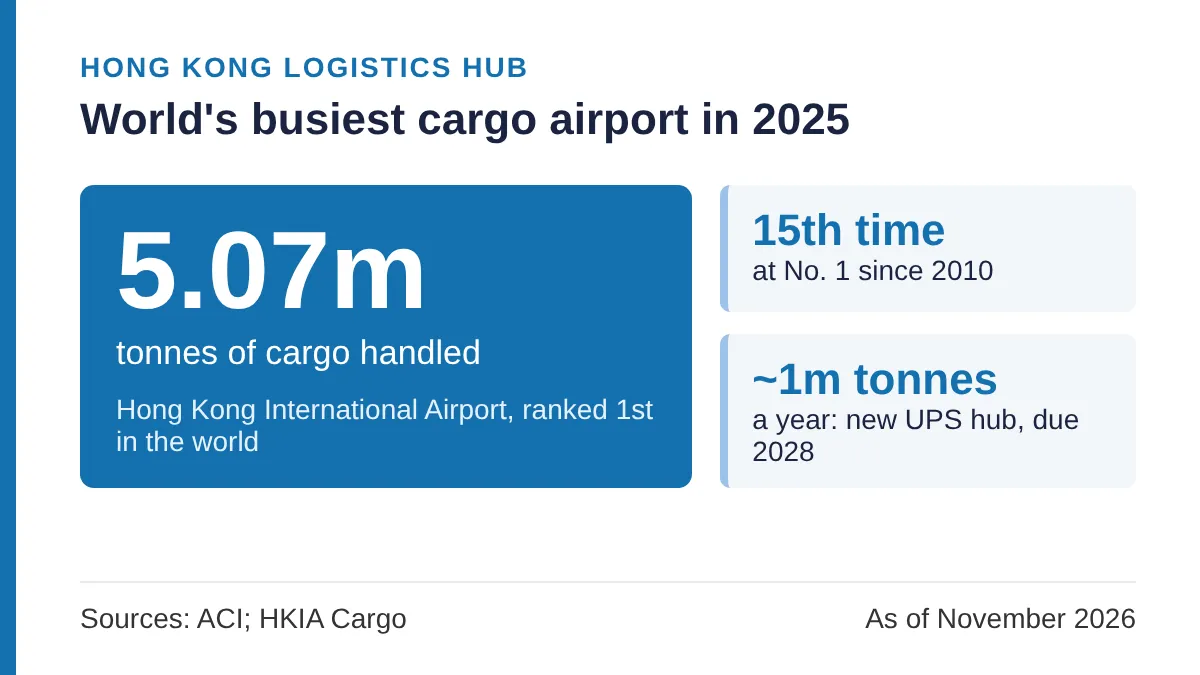
In 2025, Hong Kong International Airport handled 5.07 million tonnes of cargo, more than any other airport in the world according to Airports Council International. It was the 15th time Hong Kong has topped the global ranking since 2010.
That position reflects decades of investment and a geography that suits air freight: within five hours' flying time of half the world's population, next door to the manufacturing heart of southern China, and connected to destinations on every continent.
More capacity is on the way. The airport's three-runway system has been fully operational since late 2024, and in March 2026 UPS began building a new regional hub at the airport, expected to handle nearly one million tonnes of cargo a year when completed in 2028.
A free port
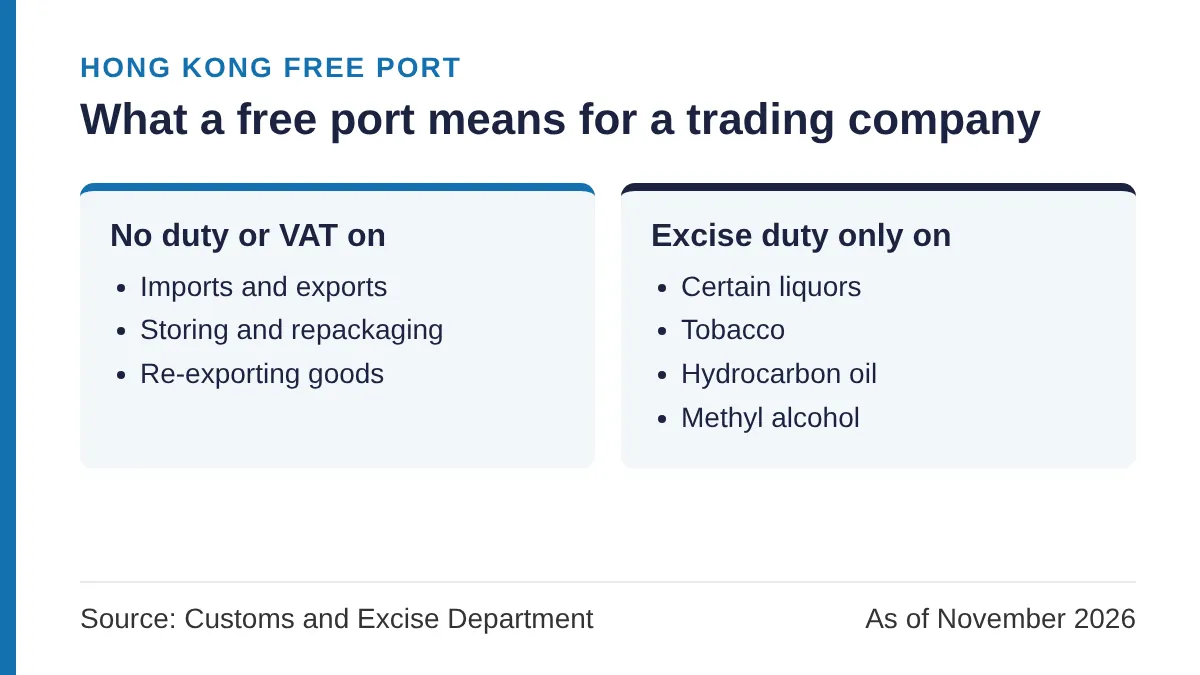
Hong Kong is a free port. It does not charge tariffs on imports or exports. Excise duties apply to only a short list of goods: certain liquors, tobacco, hydrocarbon oil and methyl alcohol.
For a trading company, that means:
- Goods can be imported, stored, repackaged and re-exported without paying duty.
- There is no VAT to register for or reclaim.
- Customs paperwork is relatively light for most goods.
Sea, land and air
Hong Kong's port remains a major container hub, although neighbouring Shenzhen and other mainland ports now handle more containers. Hong Kong's advantage increasingly lies in high-value, time-sensitive cargo and in combining modes:
- Sea-air transfers, where goods arrive by sea and leave by air.
- Cross-boundary trucking and river trade with the Pearl River Delta.
- Inter-modal links such as the logistics park in Dongguan that connects mainland exporters directly with the airport's cargo handling.
Why logistics matters even if your goods never touch Hong Kong
Many Hong Kong trading companies never physically handle their goods. A Hong Kong company may buy from a factory in Vietnam and sell to a buyer in Kenya, with goods shipped directly. So why does Hong Kong's logistics strength still matter?
- Expertise. Freight forwarders, inspection companies, insurers and trade financiers are concentrated in Hong Kong, and they work on goods moving anywhere in Asia.
- Options. When direct shipping is not the best route, consolidation, storage or air freight through Hong Kong is available.
- Documentation. Banks financing trade, and buyers paying for it, rely on shipping documents. Hong Kong's ecosystem handles them routinely.
- One location for everything. Contracting, banking, trade finance, insurance and logistics can all be arranged in the same city and time zone.
A note on rules of origin
A free port is not the same as a place of origin. Goods that are simply transshipped through Hong Kong keep their original country of origin. Goods made in Hong Kong are treated as Chinese-origin by the United States for tariff purposes. If tariffs matter to your customers, check origin rules carefully and keep the paperwork that proves where goods were made.
Using Hong Kong as a trading base
For companies that buy and sell physical goods across Asia, Hong Kong combines a world-class logistics network with simple taxation and deep trade finance. A typical set-up is a Hong Kong trading company with multi-currency banking, working with forwarders and suppliers across the region. For businesses selling into emerging markets, adding faster payment rails closes the loop between shipping goods and getting paid.
Frequently asked questions
Is Hong Kong the busiest cargo airport in the world?
Yes. Airports Council International's full-year 2025 data ranked Hong Kong International Airport first by cargo throughput, with 5.07 million tonnes.
Does Hong Kong charge import duties?
Hong Kong is a free port and does not levy tariffs on imports or exports. Excise duties apply only to a few commodities, such as certain liquors, tobacco, hydrocarbon oil and methyl alcohol.
Do goods have to pass through Hong Kong to use a Hong Kong company?
No. Many Hong Kong trading companies ship goods directly from the factory to the customer. Hong Kong's logistics network is an option, not a requirement.
Sources
This article is general information, not legal or tax advice. Rules and figures can change; confirm details for your situation before acting.