
Hong Kong's Global Position
Hong Kong 2026 Policy Address and Budget: what they mean for companies
Hong Kong 2026 Policy Address and 2026-27 Budget for companies: unchanged profits tax rates, the HK$3,000 reduction, IP deductions and new headquarters incentives.

Hong Kong sets its business agenda twice a year. The Budget in February decides tax rates and one-off relief. The Policy Address in September sets longer-term direction and incentives. This guide reads both from the point of view of a founder or finance lead abroad, as of November 2026, and separates what is already law from what is still a proposal.
What did the 2026 Policy Address and 2026-27 Budget change for companies?
For most small and mid-sized companies, very little changed. Tax rates stayed the same, a small one-off reduction applies to last year's tax, and the new incentives target specific activities such as headquarters, treasury and intellectual property.
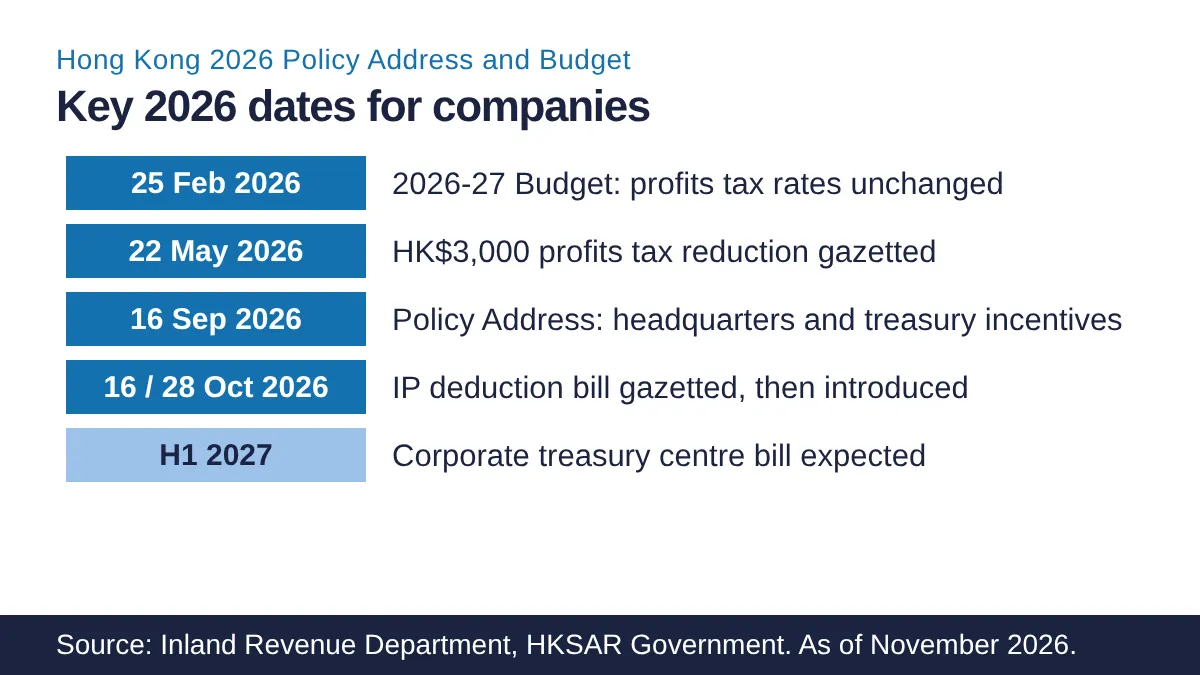
The Budget was delivered on 25 February 2026. The Policy Address was delivered by the Chief Executive at the Legislative Council on 16 September 2026. It introduced Hong Kong's first Five-Year Plan, covering 2026 to 2030. The address reported growth of 3.6% in 2025 and 5.1% year on year in the first half of 2026.
| Measure | Who it affects | Status (as of November 2026) |
|---|---|---|
| Two-tier profits tax rates unchanged | All companies | In force |
| 100% reduction of 2025/26 profits tax, capped at HK$3,000 | Most profitable businesses | Gazetted 22 May 2026 |
| Relaxed intra-group stamp duty relief | Groups moving assets between related companies | Proposed; needs legislation |
| Tax deductions for buying IP and upfront licence fees | Companies acquiring or licensing IP | Bill introduced 28 October 2026 |
| 5% or half-rate concession for supply chain headquarters | Selected high value-added enterprises | Case-by-case policy offer |
| Extra benefits for corporate treasury centres | Pre-approved treasury centres | Bill expected first half of 2027 |
Are Hong Kong's profits tax rates still the same in 2026?
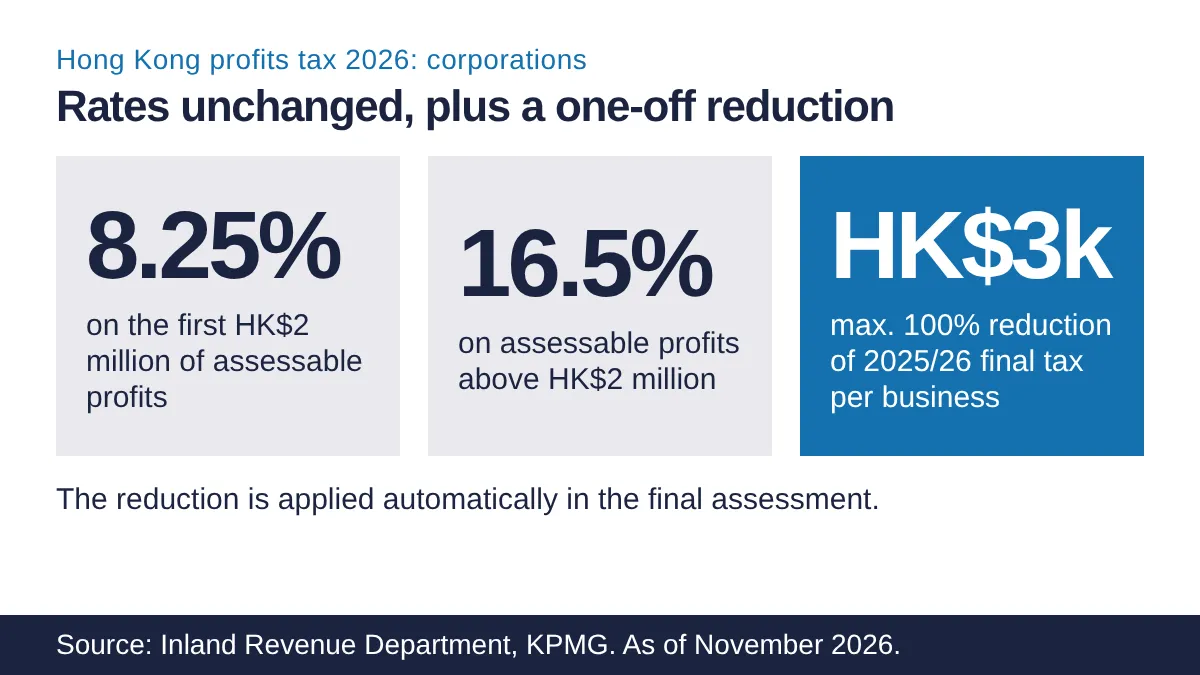
Yes. Corporations pay 8.25% on the first HK$2 million of assessable profits and 16.5% on the remainder. Unincorporated businesses pay 7.5% and 15%.
Only one company in a group of connected entities can use the lower tier in a year. Our guide to the two-tier profits tax explains how this works with worked numbers.
Neither speech proposed a change to the rates for future years. For planning, that means a company can budget on the same two tiers it used in 2025.
How does the HK$3,000 profits tax reduction work?
The reduction is automatic. You file your 2025/26 profits tax return as usual, and the Inland Revenue Department reduces the final tax by 100%, up to HK$3,000 per business.
A few points matter for overseas owners:
- The reduction applies to final tax for 2025/26. It does not reduce provisional tax, so pay demand notes as stated.
- Provisional tax already paid is set against the final tax, and any excess is refunded.
- The Government expected about 171,000 businesses to benefit.
- For a small company, HK$3,000 can cancel the whole tax bill. Larger companies will notice it less.
Timing is worth watching too. For represented companies with a March year-end, the Inland Revenue Department extended the 2025/26 deadline on 20 October 2026. Paper returns are now due by 30 November 2026 and electronic returns by 30 December 2026. Our corporate tax team tracks these dates as part of each filing.
What new incentives target headquarters and treasury centres?
The Policy Address offered two incentives for regional operations. Both target specific activities and need an application or approval.
- Supply chain headquarters. A tax concession of 5%, or half-rate, may be offered to high value-added enterprises that set up headquarters or regional headquarters in Hong Kong to manage supply chain and sourcing. It is offered case by case, based on the investment plan and actual contribution to the economy.
- Corporate treasury centres. After a review and public consultation, pre-approved treasury centres and their associated companies would get additional tax benefits and flexibilities. A bill is expected in the first half of 2027.
These are most relevant to groups that already run, or plan to run, regional management from Hong Kong. Our article on Hong Kong holding company structures covers how such a group is usually organised.
What does the IP tax deduction bill mean for my company?
The bill would let companies deduct capital spending on buying intellectual property rights, and upfront fees for licensing them. It was gazetted on 16 October 2026 and introduced into the Legislative Council on 28 October 2026.
As drafted, it covers three situations:
- Buying eligible IP rights from associates, such as group companies.
- Buying eligible IP rights used by a licensee outside Hong Kong, where the licensing income is taxable in Hong Kong. The deduction is proportionate.
- Upfront licence fees paid to use eligible IP rights.
It would apply to contracts entered into on or after 1 April 2026. Anti-abuse rules include a main purpose test and, above a set threshold, an independent valuation report. If your group holds brands, software or patents, this is worth reviewing with an adviser before you move IP between companies.
What other 2026 changes should overseas founders know about?
Several smaller changes affect day-to-day operations, especially for trading companies.
- Trade documents. The Policy Address said a bill to digitalise business-to-business trade documents would be introduced this year.
- Trade Single Window. Phase 3 will give one platform for import and export declarations.
- Tokenised deposits. The HKMA will explore trade-financing pilot transactions with the Mainland using tokenised deposits, to be completed by year-end. This links to wider work on cross-border payments.
- Crypto reporting. On 4 November 2026 the Legislative Council passed a bill implementing the Crypto-Asset Reporting Framework and an amended Common Reporting Standard.
- Global minimum tax. Since 26 October 2026, in-scope multinational groups can file top-up tax returns through the Inland Revenue Department's Pillar Two Portal. This affects large groups only, as our guide to what the global minimum tax means for smaller companies explains.
The practical message for a small or mid-sized company is stability. Rates, filing routines and audit duties are unchanged. Our guide to Hong Kong audit requirements covers the yearly accounts that every company still needs. If you are still deciding where to incorporate, our incorporation page sets out the steps.
Frequently asked questions
Did the 2026-27 Budget change Hong Kong's profits tax rates?
No. Corporations still pay 8.25% on the first HK$2 million of assessable profits and 16.5% on the rest. The Budget added a one-off reduction of 2025/26 final profits tax, capped at HK$3,000 per business.
Do I need to apply for the HK$3,000 profits tax reduction?
No. Businesses file their profits tax return as usual and the Inland Revenue Department applies the reduction in the 2025/26 final assessment. It does not reduce provisional tax.
Who can get the 5% or half-rate tax concession from the 2026 Policy Address?
The Policy Address says it may be offered to high value-added enterprises that set up headquarters or regional headquarters in Hong Kong to manage supply chain and sourcing. It is offered case by case, based on the investment plan and actual contribution.
When will the new IP tax deductions apply?
The bill was introduced into the Legislative Council on 28 October 2026. If passed as drafted, it applies to contracts entered into on or after 1 April 2026.
Sources
This article is general information, not legal or tax advice. Rules and figures can change; confirm details for your situation before acting.


