
Tax
Hong Kong Pillar Two global minimum tax: what changes for SMEs
Hong Kong Pillar Two global minimum tax explained for SMEs: who is in scope at EUR 750m revenue, the 15% rate, HKMTT filing deadlines and what small firms can ignore.

Pillar Two is the global agreement that large multinational groups should pay at least 15% tax wherever they operate. Hong Kong has put it into law, and the first top-up tax returns are now being prepared. Many small business owners have asked whether it raises their tax. For most, it does not. This guide explains who is affected and what to watch, as of November 2026.
What is the Pillar Two global minimum tax in Hong Kong?
It is a set of rules that makes large multinational groups pay a minimum 15% effective tax rate. Hong Kong enacted its law on 6 June 2025.
The Inland Revenue Department (IRD) applies two main rules:
- Income inclusion rule (IIR). A Hong Kong parent pays top-up tax on low-taxed profits of its group entities abroad.
- Hong Kong minimum top-up tax (HKMTT). Hong Kong entities of an in-scope group pay top-up tax locally if their Hong Kong effective rate falls below 15%.
Both apply to fiscal years beginning on or after 1 January 2025. A third rule, the undertaxed profits rule (UTPR), has no start date yet. The IRD says Hong Kong has transitional qualified status for its IIR, HKMTT and QDMTT safe harbour from 1 January 2025. That status matters for how other countries treat the top-up tax Hong Kong collects.
Does Pillar Two apply to small and medium-sized companies?
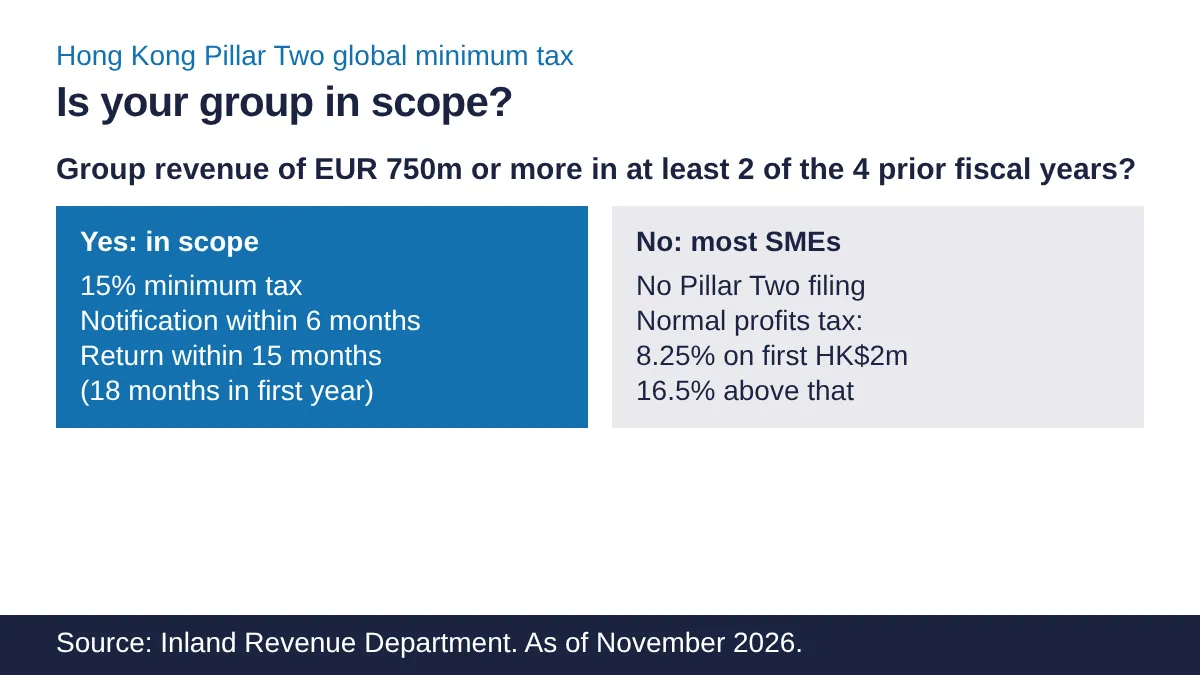
No, unless the company belongs to a very large group. The rules cover multinational groups with annual consolidated revenue of EUR 750 million or more in at least two of the four preceding fiscal years.
A founder-owned trading company, a regional holding company for a mid-sized group or a start-up is almost always below that line. These companies have no top-up tax notification and no top-up tax return to file. They keep paying normal profits tax under the two-tier profits tax system.
The threshold looks at the whole group, so size is measured at the top. A small Hong Kong subsidiary can still be in scope if its parent group crosses EUR 750 million.
| Your situation | Pillar Two in Hong Kong? |
|---|---|
| Standalone Hong Kong company owned by a founder | No |
| Hong Kong company in a group below EUR 750m revenue | No |
| Hong Kong subsidiary of a group at or above EUR 750m in 2 of 4 prior years | Yes, notification and return |
| Hong Kong parent of such a group | Yes, IIR and HKMTT may apply |
What do in-scope Hong Kong companies have to file, and when?
They file a top-up tax notification and a top-up tax return each year. The notification is due within 6 months after the fiscal year ends. The return is due within 15 months, extended to 18 months for the first transition year.
Each Hong Kong constituent entity generally files a return, even when no top-up tax is payable. Group arrangements can reduce this, for example when one Hong Kong entity is named as the designated filing entity. Any top-up tax is due one month after the later of the filing deadline and the notice of assessment. Records must be kept for at least 9 years.
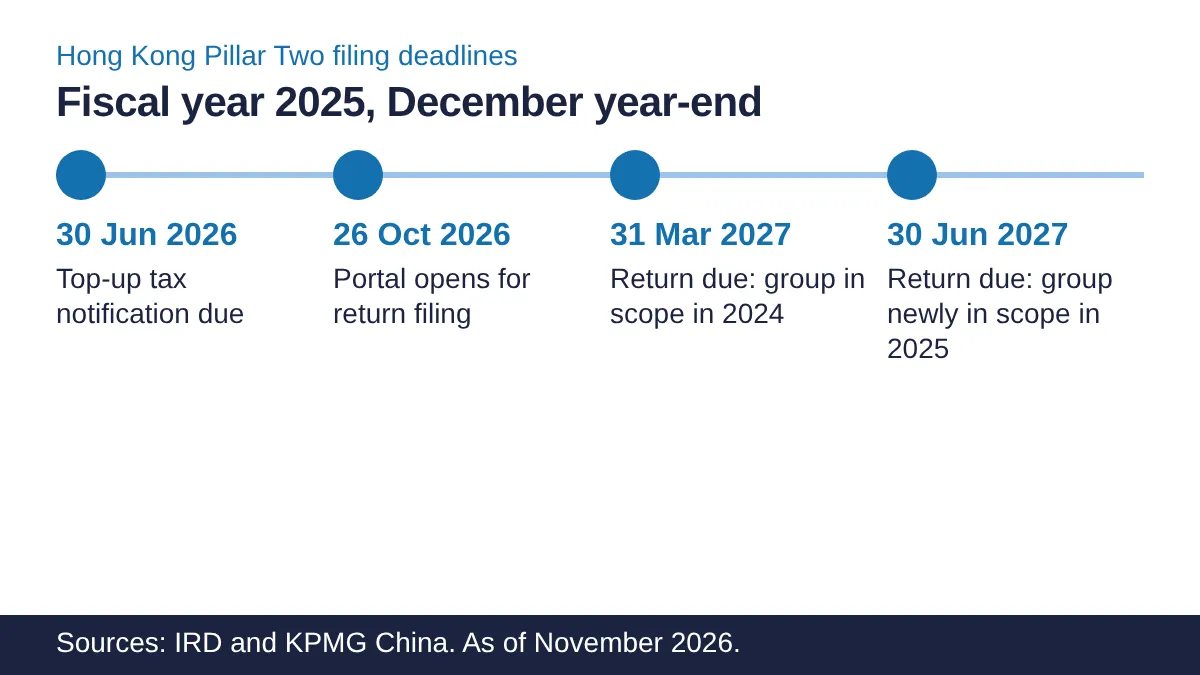
KPMG China sets out the first deadlines for a December year-end group:
- Fiscal year 2025 notification: 30 June 2026 (30 September 2026 for a March year-end).
- Fiscal year 2025 return, group in scope in 2024: 31 March 2027 (30 June 2027 for a March year-end).
- Fiscal year 2025 return, group newly in scope in 2025: 30 June 2027 (30 September 2027 for a March year-end).
Filing is online only. The IRD Pillar Two Portal needs a Business Tax Portal account, a business registration number and an organisational e-Cert with AEOI functions. Groups apply for a group code on Form IR1485. The IRD launched the return filing functions on 26 October 2026, so groups can now file.
How does the OECD side-by-side package affect US-owned groups?
It helps US-parented groups with the IIR and UTPR, and leaves the HKMTT in place. The OECD announced the package on 5 January 2026.
Under the package, a group whose ultimate parent is in a jurisdiction with a qualified side-by-side regime can elect a top-up tax of zero under the IIR and UTPR. As of 1 January 2026, the United States is the only such jurisdiction. The safe harbour applies to fiscal years beginning on or after 1 January 2026. Mayer Brown notes that domestic minimum top-up taxes are unaffected.
In practice, a Hong Kong subsidiary of a large US group should still expect to file and, where its Hong Kong rate is below 15%, pay HKMTT. Large groups headquartered in the United Kingdom or South Africa follow their home country's own minimum tax rules. Those rules differ, so check with a home-country adviser.
Will Pillar Two change Hong Kong's low tax rates?
Not for companies outside the regime. The profits tax rates are unchanged: 8.25% on the first HK$2 million of assessable profits and 16.5% on the rest.
Here is a simple example. A standalone Hong Kong company with HK$2 million of assessable profits pays HK$165,000 of profits tax, an effective rate of 8.25%. That is below 15%, but Pillar Two does not apply because the company is far below the revenue threshold.
The same is true of the offshore profits exemption. A small company with genuinely offshore profits can still claim it. For in-scope groups, though, low-taxed Hong Kong profits may now attract HKMTT. That changes how large groups use a Hong Kong holding company, and our guide to the 2026 Policy Address and Budget covers the wider tax measures.
What should growing companies do now?
Most SMEs need no action today. A few simple checks help if you are growing, raising money or selling to a large group.
- Know your group. If an investor or buyer takes a controlling stake, your company may join a group above EUR 750 million.
- Keep clean accounts. Pillar Two calculations start from the group's financial accounts, so good accounting records help if you are ever in scope.
- Watch the safe harbours. The OECD package extended the transitional country-by-country reporting safe harbour by one year, up to the year ending 31 December 2027 for December year-end groups.
- Plan holding structures with the minimum tax in mind. Our corporate tax team can model the Hong Kong position for a group near the threshold.
Frequently asked questions
Does Pillar Two apply to my small Hong Kong company?
Only if your company is part of a multinational group with consolidated revenue of EUR 750 million or more in at least two of the four preceding fiscal years. Most SMEs and founder-owned companies are below this and have nothing to file.
What is the HKMTT?
It is Hong Kong's domestic minimum top-up tax. It tops up the tax of in-scope Hong Kong entities to the 15% minimum, so Hong Kong collects the top-up tax instead of another country.
When is the first Hong Kong top-up tax return due?
For a December year-end group, the FY2025 return is due on 31 March 2027 if the group was in scope in 2024, or 30 June 2027 if it was newly in scope in 2025, according to KPMG.
Does the OECD side-by-side package remove HKMTT for US-parented groups?
No. The package, announced on 5 January 2026, lets qualifying US-parented groups elect a zero top-up tax under the IIR and UTPR, but domestic minimum top-up taxes are unaffected.
Sources
This article is general information, not legal or tax advice. Rules and figures can change; confirm details for your situation before acting.


