

Tax
Hong Kong holding company structure: a practical guide for regional groups
How a Hong Kong holding company structure works for regional groups: dividends, share gains, the FSIE participation exemption, substance and treaties in 2026.

A holding company sits at the top of a group, or of one region within it. It owns shares in operating companies, receives their dividends and, one day, may sell them. Hong Kong is a long-standing choice for this role in Asia. This guide explains how a Hong Kong holding company structure works as of November 2026, where it helps, and where it needs care.
What does a Hong Kong holding company do?
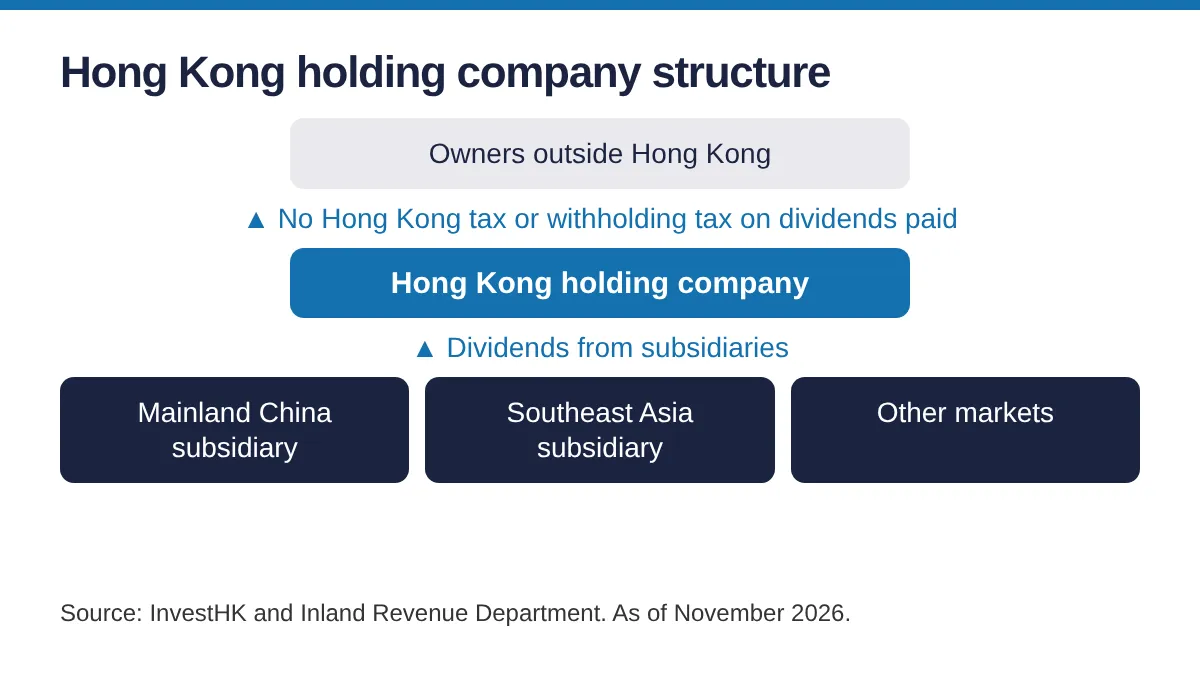
A Hong Kong holding company owns shares in subsidiaries, usually in Mainland China, Southeast Asia or other Asian markets. It collects dividends, holds the group's investments and gives the owners one place to manage the region.
Common reasons to use one:
- One entity to sell or list. Investors can buy, or a group can list, one company instead of several.
- Cleaner ownership. New subsidiaries, joint ventures and intellectual property can sit under one parent.
- Regional treasury. Dividends can be pooled and redeployed in Asia without first flowing back to the owners.
- Banking and legal system. Hong Kong's banks and courts are familiar to investors worldwide.
A holding company also gives you an option for later. If you plan a Hong Kong IPO or a trade sale, a clean structure built early is far easier than one rebuilt under deadline.
How are dividends and gains taxed in Hong Kong?
Hong Kong charges no tax on dividends, no withholding tax on dividends and interest, and no capital gains tax. Profits tax applies only to profits from a trade or business carried on in Hong Kong.
That simple position has two refinements for holding companies:
- Foreign income received in Hong Kong. The foreign-sourced income exemption (FSIE) regime can tax certain foreign dividends, interest, IP income and disposal gains received in Hong Kong by members of multinational groups, unless an exception applies.
- Selling shares. A gain on selling shares can be taxable if it is a trading gain. The Tax Certainty Enhancement Scheme gives a clear safe harbour for long-term holdings.
Our article on territorial taxation and the offshore profits exemption explains the wider source rules.
How does the FSIE participation exemption work?
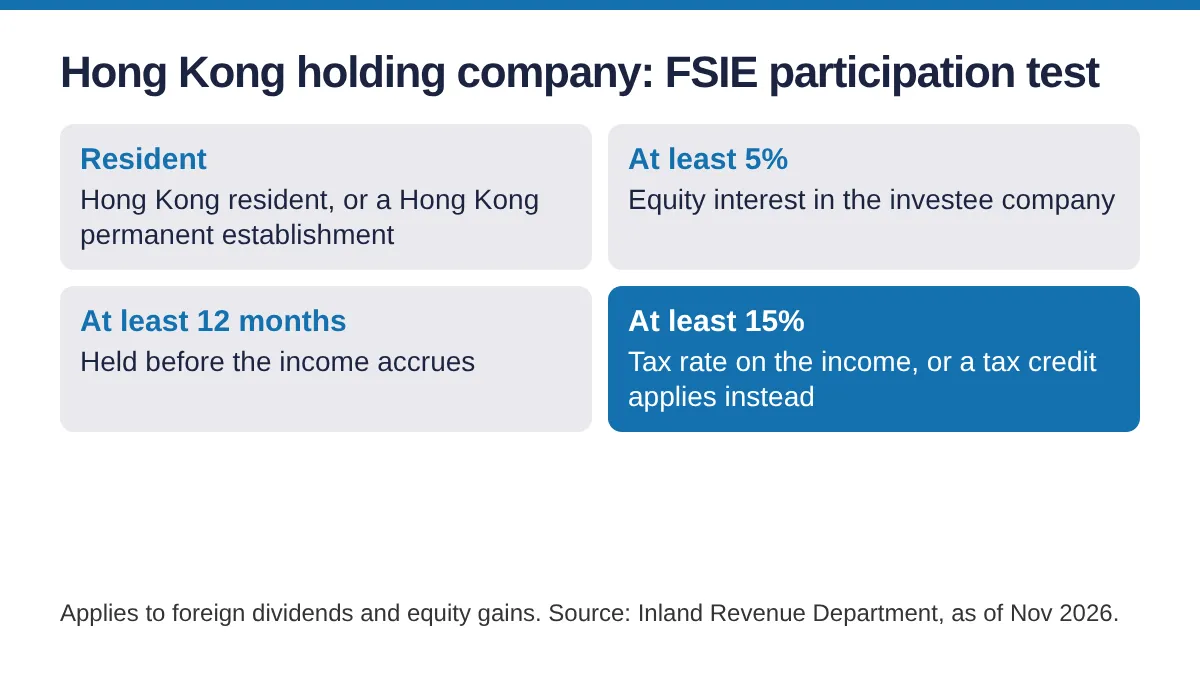
Foreign dividends and equity disposal gains received in Hong Kong are exempt if the Hong Kong company meets either the economic substance requirement or the participation requirement. The FSIE regime applies only to entities in multinational groups, which most regional holding structures are.
| FSIE test | What it requires (as of November 2026) |
|---|---|
| Covered income | Foreign interest, dividends, IP income and equity disposal gains from 1 January 2023; other disposal gains from 1 January 2024 |
| Taxed only if | Received in Hong Kong |
| Participation requirement | Hong Kong resident (or Hong Kong permanent establishment), holding at least 5% for at least 12 months |
| Subject-to-tax switch-over | If the income is not taxed at an applicable rate of at least 15%, relief becomes a tax credit instead of an exemption |
| Economic substance | Alternative route; for pure holding companies, filings plus adequate people and premises |
| Intra-group transfers | Tax on gains can be deferred between entities with 75% common ownership |
For most trading subsidiaries in Asia, the participation route works well because local corporate tax rates are often at or above 15%. Subsidiaries in low-tax jurisdictions need a closer look.
What economic substance does a holding company need?
A pure equity-holding company needs to meet its statutory registration and filing requirements and have adequate human resources and premises to hold and manage its investments. There is no fixed minimum number of staff or amount of spending.
Many holding companies meet this by outsourcing to a Hong Kong service provider. The IRD accepts outsourcing if the arrangement is documented and the outsourced activities are adequately monitored. In practice that means:
- Board decisions on investments taken and minuted properly.
- Annual returns and filings made on time through a company secretary.
- Audited accounts that show the holding activity clearly, prepared with your accounting provider.
If the company does more than hold shares, for example lending to subsidiaries at scale, it stops being a pure holding company. A fuller substance test then applies.
When are share sale gains safe from tax?
Onshore gains on selling shares can be treated as non-taxable under the Tax Certainty Enhancement Scheme if the company held at least 15% of the investee for a continuous 24 months before the sale. The scheme applies to disposals from 1 January 2024.
Some disposals are excluded. These include shares held as trading stock, shares held by insurers, and certain unlisted shares in property companies. Gains outside the scheme are judged on the usual "badges of trade" approach.
What should US, UK and South African owners check at home?
Your home country's rules often matter more than Hong Kong's. A Hong Kong holding company does not change where the owners live, and home-country tax can apply to its profits or dividends.
- Tax treaties. As of October 2026, Hong Kong had signed comprehensive tax treaties with 60 jurisdictions. The United Kingdom and South Africa are on the list. The United States is not. See our guide to Hong Kong's tax treaty network.
- Controlled foreign company rules. The US, the UK and South Africa all have rules that can tax residents on profits of companies they control abroad. Check them with a home-country adviser before you set up, and map the Hong Kong side through a corporate tax review.
- Two-tier rates. Only one company in a group of connected entities can elect Hong Kong's 8.25% rate on the first HK$2 million of profits.
If your current parent company is incorporated elsewhere, you may not need a new one. Hong Kong's re-domiciliation regime lets eligible companies move their place of incorporation to Hong Kong while keeping the same legal entity.
Frequently asked questions
Are dividends taxed in Hong Kong?
Hong Kong does not tax dividends and does not charge withholding tax on dividends paid out. Foreign dividends received by members of multinational groups fall under the FSIE regime and are exempt if an exception applies.
What is the FSIE participation exemption?
It exempts foreign dividends and equity disposal gains received in Hong Kong where the Hong Kong company holds at least 5% of the investee for at least 12 months, subject to a 15% subject-to-tax test.
Does a Hong Kong holding company need staff and an office?
A pure equity-holding company needs to meet its statutory filing requirements and have adequate human resources and premises for holding its investments. Outsourcing to a Hong Kong service provider is allowed if it is adequately monitored.
Can each group company use the lower 8.25% tax rate?
No. Only one entity in a group of connected entities can elect the two-tier rates for a year of assessment.
Sources
This article is general information, not legal or tax advice. Rules and figures can change; confirm details for your situation before acting.


