
Tax
Hong Kong audit requirements: accounting rules for foreign-owned companies
Hong Kong audit requirements for foreign-owned companies: who must be audited, who can audit, the small company reporting exemption and 7-year record rules.

Many overseas founders are surprised that a small Hong Kong company needs a full audit every year. Hong Kong has no size-based audit exemption for active companies. The upside is a clean set of audited accounts that banks, investors and tax authorities trust. This guide explains the rules for foreign-owned companies, as of November 2026.
Does every Hong Kong company need an audit?
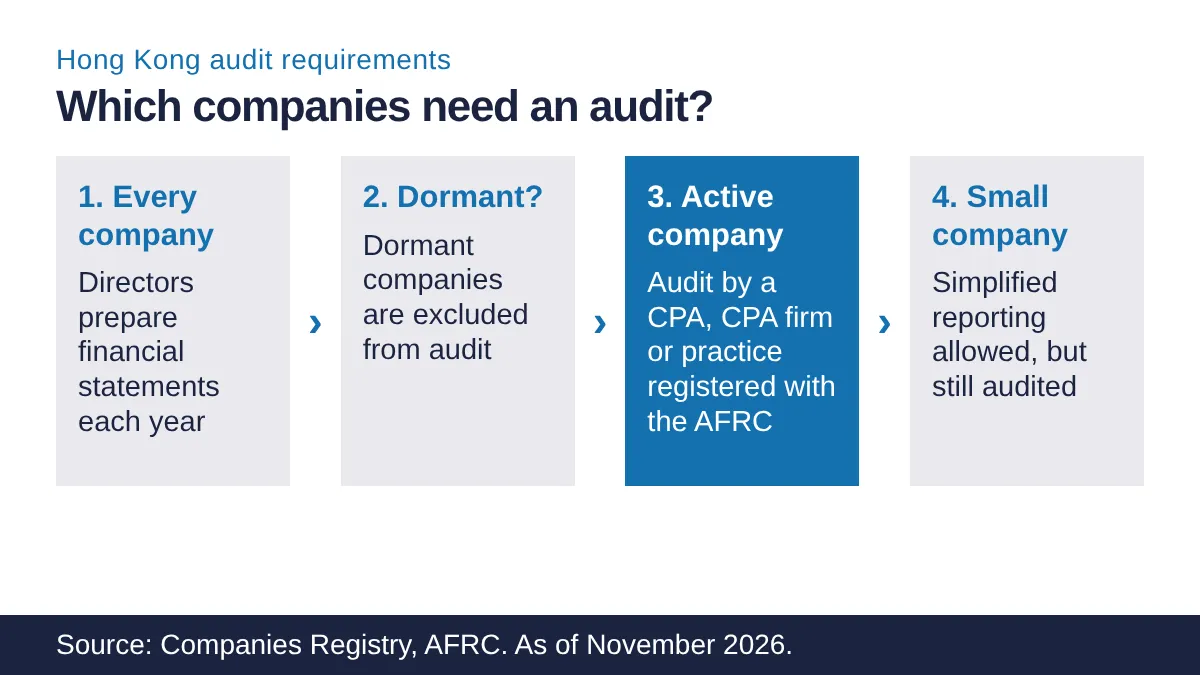
Yes, unless the company is dormant. The Companies Registry states that audit of the financial statements is required for all companies, including those that use the reporting exemption.
The directors must prepare financial statements for each financial year. If the company is a holding company at year-end, they must prepare consolidated statements for the group. Full statements must give a true and fair view of the company's financial position at year-end.
This applies whether the shareholders live in Hong Kong, the United States, the United Kingdom or South Africa. Foreign ownership does not change the duty. A dormant company is the main exception, and the financial reporting requirements do not apply to it.
Who is allowed to audit a Hong Kong company?
Only an auditor registered in Hong Kong. The Accounting and Financial Reporting Council (AFRC) says only a CPA (practising), a CPA firm or a corporate practice registered with it can hold an appointment as auditor.
That rule covers audits of companies under the Companies Ordinance. In practice, a home-country accountant can still prepare your bookkeeping and management accounts. The statutory audit itself must be signed by a registered Hong Kong practice. Our accounting service prepares the books and coordinates the audit, so the two sides work from the same records.
What is the small private company reporting exemption?
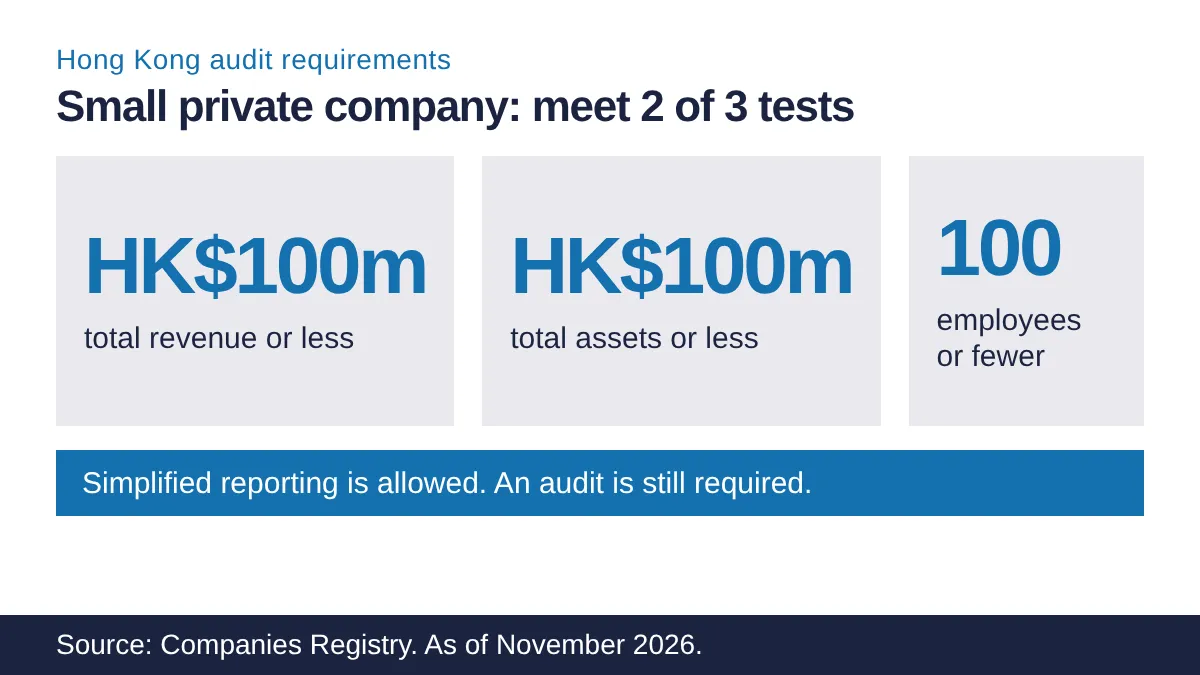
It is a lighter reporting regime for smaller companies. It reduces what the financial statements and directors' report must contain. It does not remove the audit.
| Route | Test | Approval needed |
|---|---|---|
| Small private company | Meets 2 of 3: revenue up to HK$100m, assets up to HK$100m, up to 100 employees | None |
| Eligible private company | Meets 2 of 3: revenue up to HK$200m, assets up to HK$200m, up to 100 employees | 75% of members approve and no member objects |
| Private company not in a group | Any size | Unanimous written agreement of members for the year |
A holding company of a group of small private companies applies the same tests to the group's combined figures. Where the unanimous agreement route is used, it must be delivered to the Registrar within 15 days.
Companies in the exemption gain three practical benefits:
- Their financial statements need not give a "true and fair view".
- They may use the Small and Medium-sized Entity Financial Reporting Standard (SME-FRS).
- Their directors' report can leave out the business review and some other disclosures.
What accounting records must a Hong Kong company keep?
A company must keep records that show and explain its transactions and its financial position at any time. They must include daily entries of money received and spent, and a record of assets and liabilities.
The Inland Revenue Department lists what it expects to see:
- Books of account recording receipts and payments, or income and expenditure.
- Source documents such as invoices, receipts, vouchers and bank statements.
- A record of the business's assets and liabilities.
- At year-end, lists of debtors and creditors and stocktake figures.
Records must be kept in English or Chinese and can be on paper or computer. They must be kept for 7 years. The Companies Ordinance counts from the end of the financial year concerned, and the Inland Revenue Department counts from the transaction date. Failing to keep records can lead to a fine of up to HK$100,000.
Can a foreign-owned company keep its books abroad?
Yes. Many overseas owners run their bookkeeping from home on cloud software. If the records are kept outside Hong Kong, accounts and returns showing the financial position at intervals of no more than 6 months must be sent to and kept in Hong Kong.
Directors must be able to inspect those accounts in Hong Kong at any time. Many companies keep them at their registered office. Our article on running a Hong Kong company remotely covers the other duties that can be managed from abroad.
How does the audit connect to the profits tax return?
The audited accounts are the basis of the profits tax return. If a company had gross income in the period, it must file its return with supporting documents, including financial statements and a tax computation.
The Inland Revenue Department has also said that small corporations with gross income up to HK$2 million may no longer file their returns without supporting documents. So even a very small trading company needs its audited accounts ready before the return is due.
Deadlines are worth checking every year. On 20 October 2026 the department extended the 2025/26 due date for represented companies with a March year-end. Paper returns are now due by 30 November 2026 and electronic returns by 30 December 2026. Our annual compliance calendar sets out the full yearly cycle. The 2026 Policy Address and Budget left these audit and filing duties unchanged.
For owners in the United States, the United Kingdom or South Africa, the audited Hong Kong accounts are often useful for home-country reporting too. The rules differ by country, so check with a home-country adviser what you must report about a company you own abroad. Our corporate tax team can share the Hong Kong figures your adviser needs.
Frequently asked questions
Does a small Hong Kong company with little revenue need an audit?
Yes. The Companies Registry says audit of the financial statements is required for all companies, including those using the reporting exemption. Only dormant companies are excluded.
Can my home-country accountant audit my Hong Kong company?
Only if they are registered in Hong Kong. The AFRC says only a CPA (practising), a CPA firm or a corporate practice registered with it can hold an appointment as auditor of a Hong Kong company.
Can I keep my company's books outside Hong Kong?
Yes, but accounts and returns showing the financial position at intervals of no more than 6 months must be sent to and kept in Hong Kong, where directors can inspect them.
How long must a Hong Kong company keep its records?
The Companies Ordinance requires records to be preserved for 7 years after the end of the financial year concerned. The Inland Revenue Department also requires 7 years and can fine up to HK$100,000 for failing to keep records.
Sources
This article is general information, not legal or tax advice. Rules and figures can change; confirm details for your situation before acting.


