

Setting Up
Hong Kong company re-domiciliation: how to move your company to Hong Kong
How Hong Kong company re-domiciliation works for overseas companies: who qualifies, steps, fees, deadlines, tax points and uptake as of November 2026.

Many groups that operate in Asia were set up years ago in another jurisdiction. Some now want their parent or regional company to sit in Hong Kong, where their bankers, managers and customers already are. Until 2025, the only route was to form a new company and transfer the business across. Hong Kong's re-domiciliation regime offers a simpler path, and this guide explains how it works as of November 2026.
What is company re-domiciliation in Hong Kong?
Re-domiciliation lets a company incorporated outside Hong Kong move its place of incorporation to Hong Kong and keep the same legal identity. The regime started on 23 May 2025 under an amendment to the Companies Ordinance.
The Companies Registry is clear that re-domiciliation does not create a new legal entity. The company keeps its property, rights, obligations, liabilities and contracts. From the re-domiciliation date, it is treated as a company incorporated in Hong Kong.
For a group, this matters. A new company would need new bank accounts, new contracts and, often, consent from lenders and counterparties. Re-domiciliation avoids most of that because the counterparty is still the same company.
The regime is inward only. It lets foreign companies move to Hong Kong. It does not let Hong Kong companies move out.
Which companies can re-domicile to Hong Kong?
A company can apply if it is comparable to one of four Hong Kong company types and meets four sets of conditions. The comparable types are private or public companies limited by shares, and private or public unlimited companies with a share capital.
The Companies Registry's guide sets out the main conditions:
- Original jurisdiction allows it. The law of the place of incorporation must allow the company to transfer its domicile to another jurisdiction, and the company must follow that law.
- Member approval. If the original law or the constitution requires members' consent, it must be obtained. If not, members must approve under the Companies Ordinance by a majority of at least 75%.
- Integrity. The company must not be used for an unlawful purpose or a purpose contrary to the public interest.
- Solvency. The company must be able to pay debts falling due within 12 months of the application date, and must not be in liquidation.
There is no economic substance test for re-domiciliation itself. The company must, however, have a registered office in Hong Kong, which our registered office service can provide.
The first condition is the one to check early. Not every jurisdiction allows companies to transfer out. If you are a founder in the United Kingdom, the United States or South Africa, ask a home-country lawyer whether your company's law of incorporation permits an outward transfer before you plan around it.
What are the steps, fees and deadlines?
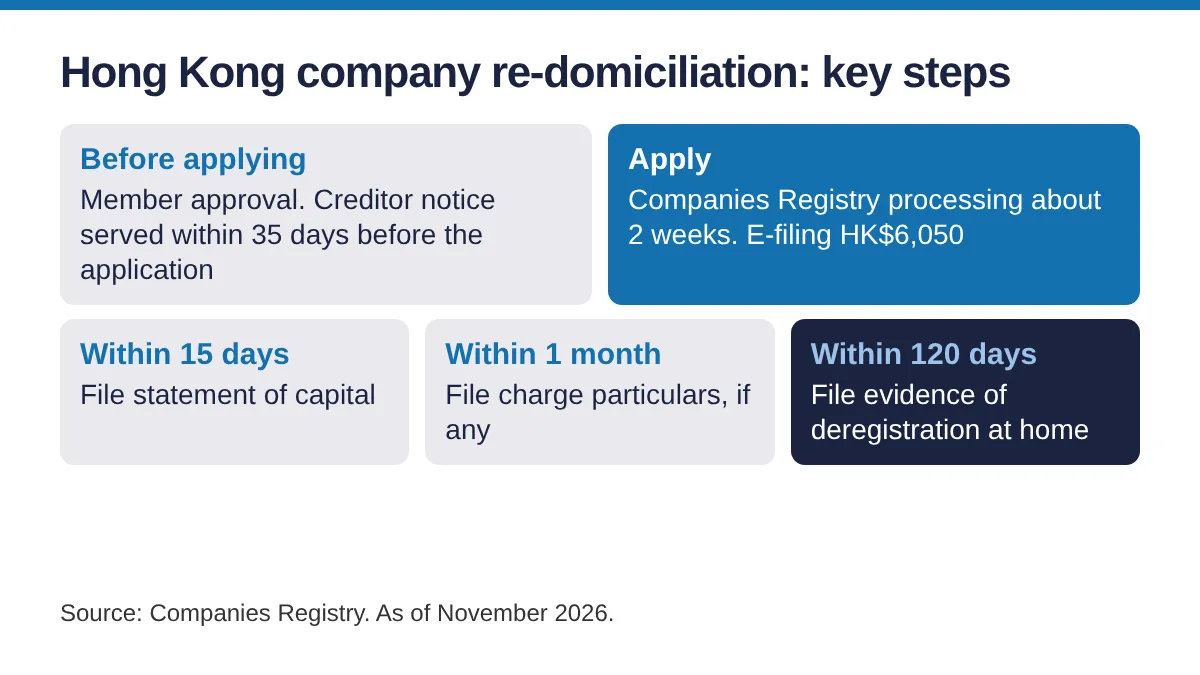
The application itself is short. Most of the work happens before it, in the original jurisdiction. The main steps are:
- Prepare in the original jurisdiction. Obtain member approval and any consents the original law requires.
- Notify creditors. The board must certify that notice of the proposal was served on all creditors within 35 days before the application date. A newspaper or gazette notice does not satisfy this on its own.
- Apply to the Companies Registry. File the re-domiciliation form with a board certificate, proposed articles of association and director consents.
- Receive the certificate. Processing takes about two weeks if the documents are in order.
- File follow-up documents. File the statement of capital within 15 days and any charge particulars within one month.
- Deregister at home. File evidence of deregistration in the original jurisdiction within 120 days. The Registrar can extend this on conditions.
| Item | Detail (as of November 2026) |
|---|---|
| Electronic application fee | HK$6,050 (HK$5,020 registration fee plus HK$1,030 lodgement fee) |
| Paper application fee | HK$6,725 (HK$5,580 plus HK$1,145) |
| Processing time | About 2 weeks if documents are in order |
| Statement of capital | Within 15 days after re-domiciliation |
| Evidence of deregistration | Within 120 days after re-domiciliation |
Missing the deregistration deadline is serious. The Registrar can revoke the registration. A company secretary who tracks these dates from day one removes most of that risk.
How is a re-domiciled company taxed?
A re-domiciled company is treated as incorporated in Hong Kong for tax purposes, so it can be regarded as a Hong Kong resident under Hong Kong's tax treaties. It can then apply for a Certificate of Resident Status to claim treaty benefits. Our guide to Hong Kong's tax treaty network explains why that can be valuable.
Hong Kong still taxes on a territorial basis. Re-domiciling does not make worldwide profits taxable in Hong Kong, and it does not remove any Hong Kong tax liability for periods before the move.
The Inland Revenue Department has added rules for the move itself:
- Exit tax relief. If the original jurisdiction taxed unrealised gains because the company left, a unilateral tax credit may be available against later Hong Kong profits tax on the same income.
- Asset values. Trading stock, intellectual property and plant brought into a Hong Kong business are valued using specific rules, generally the lower of tax-written-down cost or market value on the re-domiciliation date.
The home country matters as much as Hong Kong here. Leaving a jurisdiction can trigger exit taxes, and shareholders may still be taxed at home under their own rules. A tax structure review before you apply is worth the time.
How many companies have re-domiciled so far?
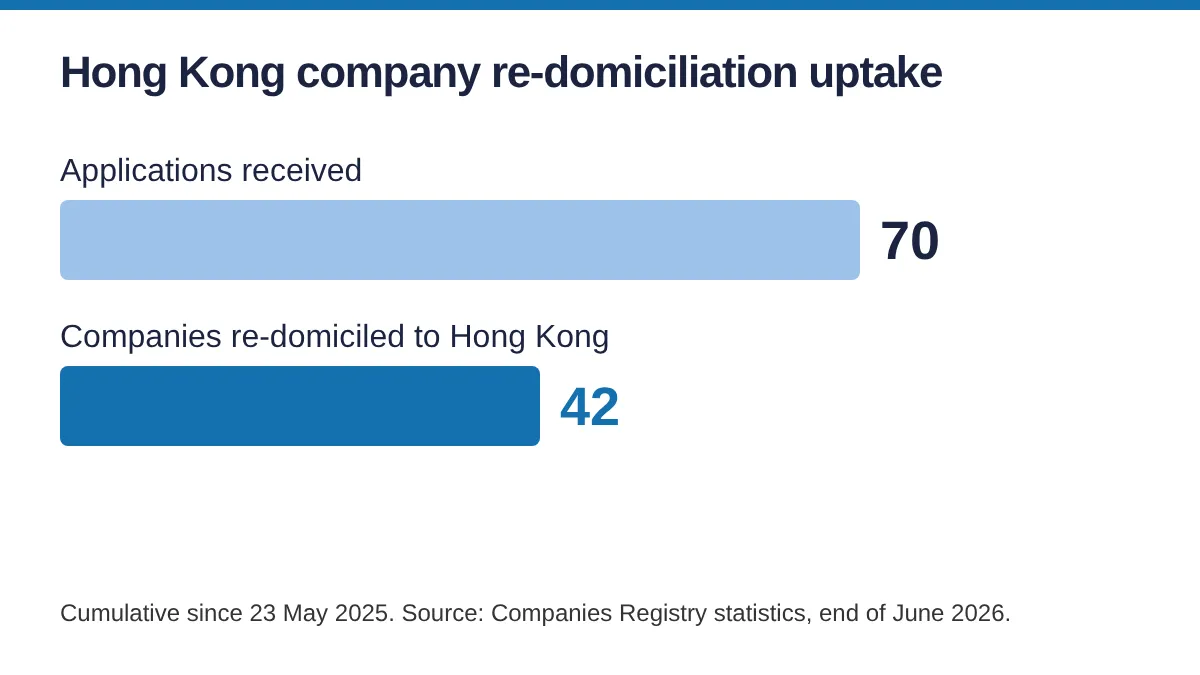
Uptake is steady and still small. By the end of June 2026, the Companies Registry had received 70 applications and 42 companies had successfully re-domiciled to Hong Kong.
For context, the same release reported 1,609,720 local and re-domiciled companies on the register at the end of June 2026. Re-domiciliation is a specialist route, used mainly by established groups with a clear reason to move.
When is re-domiciliation the right choice?
Re-domiciliation suits an existing company with history, contracts and assets that would be costly to transfer. A new Hong Kong company is usually simpler if you are starting fresh.
| Situation | Usually better route |
|---|---|
| Existing holding company with subsidiaries and bank facilities | Re-domiciliation |
| Company with many long-term contracts or licences | Re-domiciliation |
| New business or new regional subsidiary | New company (how to set up a company in Hong Kong) |
| Original jurisdiction does not allow outward transfer | New company, then transfer business or shares |
Groups that move a holding company often review the wider structure at the same time. Our guide to Hong Kong holding company structures covers how dividends, gains and substance work once the parent sits in Hong Kong.
Frequently asked questions
What is company re-domiciliation in Hong Kong?
It is a procedure that lets a company incorporated outside Hong Kong transfer its place of incorporation to Hong Kong while keeping the same legal identity, contracts, assets and liabilities.
How long does re-domiciliation to Hong Kong take?
The Companies Registry says an application is processed in about two weeks if the documents are in order. Preparation in the original jurisdiction, such as member approval and creditor notice, usually takes longer.
Does a re-domiciled company become a Hong Kong tax resident?
A re-domiciled company is treated as incorporated in Hong Kong for Inland Revenue Ordinance purposes, so it can be regarded as a Hong Kong resident under tax treaties and can apply for a Certificate of Resident Status.
Can any foreign company re-domicile to Hong Kong?
No. The law of the original jurisdiction must allow the company to transfer out, and the company must be comparable to a Hong Kong company limited by shares or an unlimited company with a share capital.
Sources
This article is general information, not legal or tax advice. Rules and figures can change; confirm details for your situation before acting.