

Setting Up
Hong Kong or Singapore for Your Asia Company? An Honest Comparison
A side-by-side comparison of company formation in Hong Kong and Singapore for foreign founders: tax, local director rules, audit, treaties, banking and which markets each serves best.

"Hong Kong or Singapore?" is one of the most common questions foreign founders ask when choosing an Asian base. Both cities are wealthy, English-speaking, common law financial centres with simple, low taxes. Both regularly appear near the top of global competitiveness rankings. And both are genuinely good choices.
The useful question is not which is better, but which is better for your business.
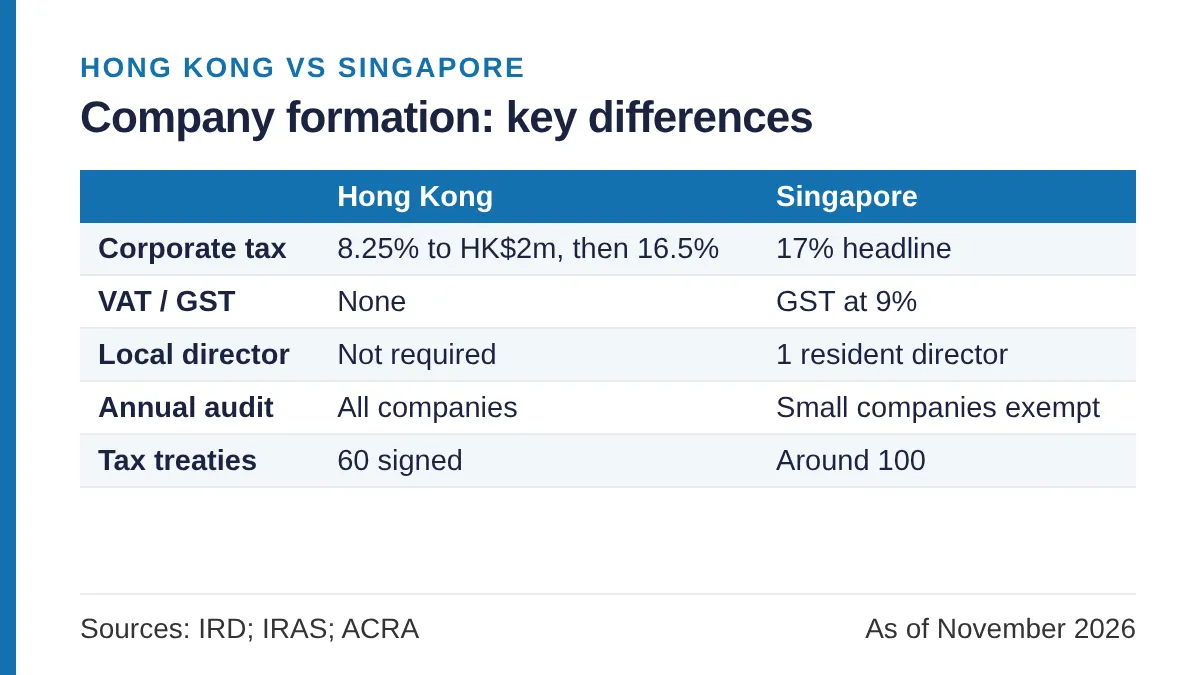
The comparison at a glance
| Hong Kong | Singapore | |
|---|---|---|
| Corporate tax | 8.25% on first HK$2m, 16.5% above | 17% headline, with partial exemptions on initial income |
| Tax basis | Territorial: only Hong Kong-sourced profits | Singapore-sourced income plus foreign income received, subject to exemptions |
| VAT / GST | None | GST at 9% |
| Dividend withholding tax | None | None |
| Local director | Not required | At least one ordinarily resident director required |
| Company secretary | Hong Kong resident individual or company | Singapore resident, appointed within six months |
| Annual audit | Required for all companies | Small companies can be exempt |
| Comprehensive tax treaties | Signed with 60 jurisdictions | Around 100 |
| Strongest regional links | Mainland China, North Asia, Greater Bay Area | Southeast Asia (ASEAN), India |
| Currency | HK dollar, linked to US dollar | Singapore dollar, managed float |
Where Hong Kong has the edge
No local director requirement
For a founder who will not live in Asia, this is often decisive. A Hong Kong company can have a single director living anywhere. In Singapore, you need at least one director who is ordinarily resident there, which for many foreign founders means paying for a nominee director.
No consumption tax
Hong Kong has no VAT or GST. Singapore charges GST at 9%, with registration required above a turnover threshold. For trading companies, Hong Kong's simplicity removes a whole compliance stream.
A lower first-tier rate
At lower profit levels, Hong Kong's 8.25% first tier generally compares well with Singapore's effective rate after exemptions.
Mainland China and capital markets
Hong Kong is the natural base for business with mainland China and the Greater Bay Area, for renminbi banking, and for companies that may one day raise capital in Hong Kong's markets, which were the world's largest by IPO funds raised in 2025.
Where Singapore has the edge
A larger treaty network
Singapore has comprehensive tax treaties with around 100 jurisdictions, compared with Hong Kong's 60 signed agreements. For holding companies receiving dividends, interest or royalties from many countries, that can matter.
Audit exemption for small companies
Small Singapore companies meeting certain criteria can be exempt from audit. Every Hong Kong company must be audited annually. (The upside of Hong Kong's rule is a clean audited track record from year one.)
Southeast Asia focus
For businesses whose customers and operations are mainly in Indonesia, Malaysia, Vietnam, Thailand or the Philippines, Singapore is the established regional centre.
A practical way to decide
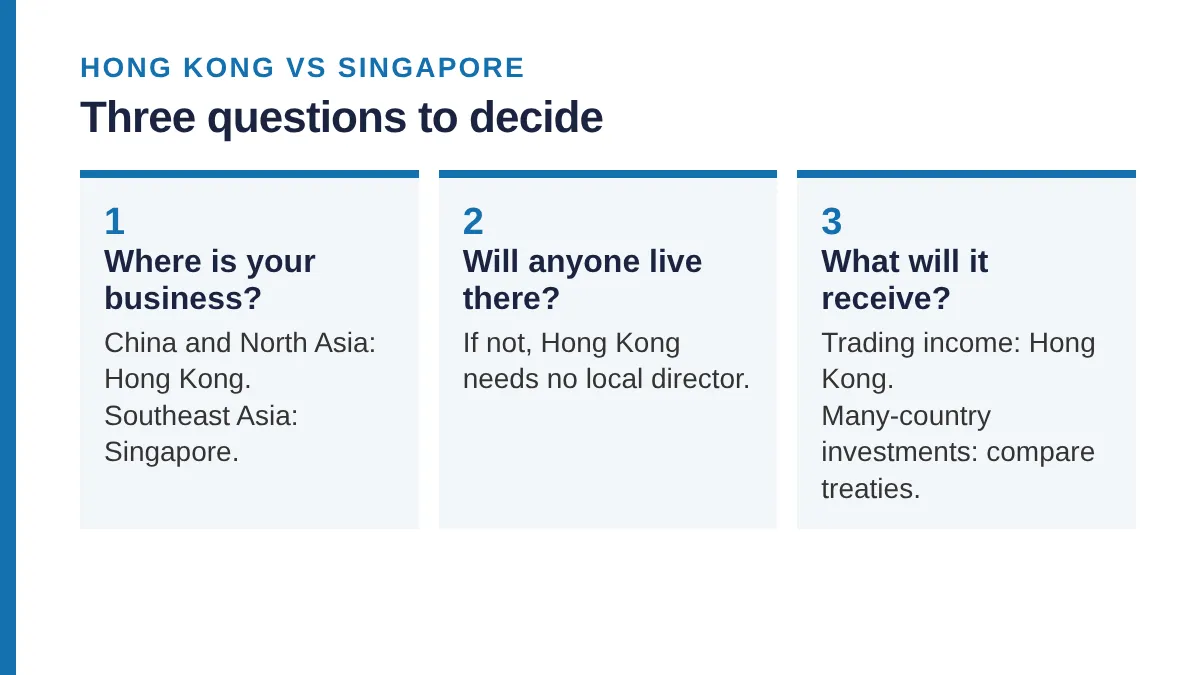
Ask three questions:
- Where are most of your customers, suppliers and partners? Mainland China and North Asia point to Hong Kong; Southeast Asia points to Singapore.
- Will anyone on your team live there? If not, Hong Kong's lack of a local director requirement is a real advantage.
- What will the company receive? If it will mainly trade, Hong Kong's territorial system and lack of GST are attractive. If it will hold investments in many countries, compare treaty coverage for your specific countries.
For businesses trading with emerging markets in Africa, the Middle East and Latin America, Hong Kong's financial depth and payment infrastructure, including its regulated stablecoin regime, are a further consideration. See our cross-border payments service for how that works in practice.
Why not both?
Larger groups often use both cities: a Hong Kong company for China and North Asia, and a Singapore company for ASEAN, sometimes under a common holding company. For most founders starting out, though, one well-run company in the right place is better than two set up too early.
If Hong Kong fits your business, we can set up your company remotely, including the company secretary and registered office.
Frequently asked questions
Is Hong Kong or Singapore better for a foreign-owned company?
Neither is better in general. Hong Kong suits businesses focused on mainland China, North Asia and cross-border trading, and founders who want no local director requirement. Singapore suits businesses focused on Southeast Asia that value its larger treaty network.
Do I need a local director in Hong Kong or Singapore?
Hong Kong does not require a local director. Singapore requires at least one director who is ordinarily resident in Singapore.
Which has lower corporate tax?
Hong Kong charges 8.25% on the first HK$2 million of profits and 16.5% above. Singapore's headline rate is 17%, reduced by partial exemptions on the first portion of income. The effective result depends on your profit level and structure.
Sources
This article is general information, not legal or tax advice. Rules and figures can change; confirm details for your situation before acting.