

Setting Up
Run a Hong Kong company remotely: do you need to move to Hong Kong?
Can you run a Hong Kong company remotely? What the law requires locally, what visitors may do on business trips, and the talent schemes if you want to move.

Many founders who set up a Hong Kong company never live there. They manage the business from London, New York, Johannesburg or elsewhere and visit when the work calls for it. This guide explains, as of November 2026, what the law requires to be in Hong Kong, what you can do on a business trip, and which visa routes exist if you decide to move.
Can you run a Hong Kong company without living in Hong Kong?
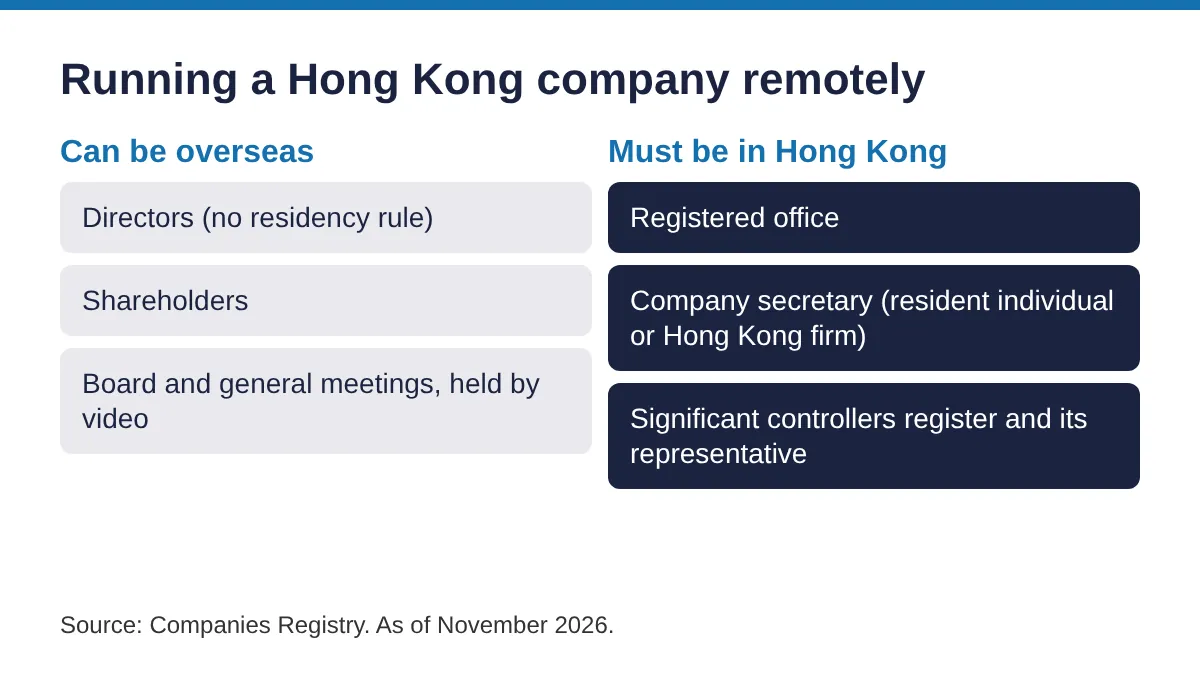
Yes. Non-residents may incorporate a local limited company, and the Companies Ordinance does not require any director to be a Hong Kong resident. A private company needs at least one director who is an individual, and that person can live anywhere.
Shareholders can also be anywhere in the world. Board meetings can be held by video, and general meetings can be held at more than one place using technology. Since 28 April 2023 the law has expressly allowed local companies to hold fully virtual and hybrid general meetings.
Incorporation itself can be done electronically through the Companies Registry's e-Filing Services. The Registry suggests that people who do not often stay in Hong Kong consider appointing a local professional firm. Our guide on how to set up a company in Hong Kong as a foreigner walks through the full process.
What must stay in Hong Kong?
Three things must be local, even if every owner and director lives abroad.
| Requirement | What the rule says (as of November 2026) | How remote owners usually meet it |
|---|---|---|
| Registered office | Must be situated in Hong Kong | A registered office service that receives and forwards official mail |
| Company secretary | An individual must ordinarily reside in Hong Kong; a corporate secretary must have its registered or principal office in Hong Kong | A licensed company secretary provider |
| Significant controllers register | Kept at the registered office or another place in Hong Kong | Held by the secretary at the registered office |
| Designated representative | A Hong Kong resident shareholder, director or employee, or an accounting or legal professional, or a licensed trust or company service provider | Usually the company secretary provider |
One detail catches sole founders. The sole director of a private company cannot also be its company secretary. A one-person company owned from abroad therefore needs an outside secretary in practice.
What can you do in Hong Kong as a business visitor?
As a visitor you can do most of the work a director travels for. The Immigration Department lists these permitted activities:
- Negotiating and signing agreements, or submitting bids.
- Overseeing the installation or packaging of goods or equipment.
- Taking part in trade fairs or exhibitions, without selling directly to the public or building booths.
- Settling compensation or other civil claims.
- Attending product orientation sessions, short-term seminars and business meetings.
The limits are clear. A visitor may not take any employment, paid or unpaid, and may not establish or join any business while in Hong Kong. Breaching a condition of stay is an offence, with a maximum fine of HK$50,000 and up to two years in prison. Owning and directing a company from abroad and visiting for meetings is a common pattern. Running its day-to-day work from a Hong Kong desk is where a work visa becomes necessary.
How long can US, UK and South African founders stay visa-free?
As of November 2026, British citizens can visit Hong Kong visa-free for 180 days, US nationals for 90 days and South African nationals for 30 days. Other nationalities have their own periods, so check the Immigration Department's list before you book.
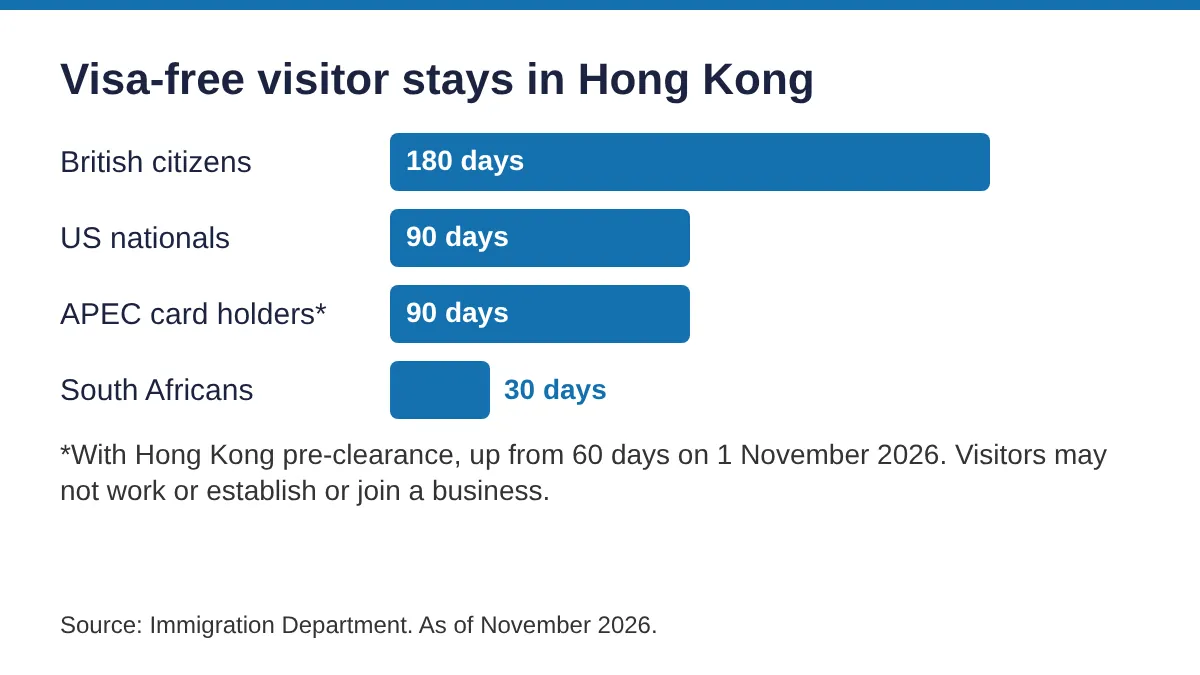
There is one recent change for frequent travellers. From 1 November 2026, holders of an APEC Business Travel Card with Hong Kong pre-clearance can stay up to 90 days visa-free, up from 60 days. Card holders still need to meet the other entry requirements.
Visa-free days decide how long you may stay. They do not change what you may do. The visitor rules above apply for the whole stay.
Which visa routes exist if you want to move?
If you want to live in Hong Kong and work in your own business, you need permission to do so. The Immigration Department runs several admission schemes. These are the ones most relevant to founders:
- General Employment Policy (entrepreneurs). For people planning to set up or join a Hong Kong business who can make a substantial contribution to the economy. Stays follow a 3+3+2 year pattern.
- Quality Migrant Admission Scheme. For highly skilled or talented people without a job offer. The General Points Test scores factors including age, qualifications, work experience, income and business ownership.
- Top Talent Pass Scheme. No job offer is needed. Category A covers people whose annual income reached HK$2.5 million or more in the year before applying. Categories B and C cover graduates of eligible universities, with different work experience rules.
Each scheme has its own documents and assessment. Treat the list above as a map and read the Immigration Department's guidance for the scheme you choose.
What do remote owners need to watch?
Running the company from abroad works well when a few practical points are covered.
- Mail and deadlines. Tax returns and notices arrive at the registered office. Make sure someone scans and flags them quickly. Our Hong Kong annual compliance calendar lists the yearly dates.
- Banking. Account opening for non-resident owners takes planning, and some banks may want to meet you. See our guide to opening a Hong Kong bank account as a non-resident.
- Where profits are made. Hong Kong taxes profits arising in or derived from Hong Kong. Where your team does the work affects the analysis, so keep records of who does what and where.
- Home-country rules. Living in the US, the UK or South Africa while owning a Hong Kong company can bring home-country reporting and tax duties. Check them with a home-country adviser before you start trading.
Frequently asked questions
Can a foreigner be the only director of a Hong Kong company?
Yes. A private company needs at least one director who is a natural person, and the Companies Ordinance does not require directors to live in Hong Kong. A sole director cannot also be the company secretary.
Do I need a Hong Kong address for my company?
Yes. The registered office must be in Hong Kong. Many overseas owners use a registered office service, which also receives official letters from the Companies Registry and the Inland Revenue Department.
Can I work in Hong Kong on a visitor visa?
No. Visitors may carry out business activities such as meetings, negotiations and trade fairs, but may not take paid or unpaid employment or establish or join a business. Working in Hong Kong needs a work visa or a talent scheme.
Which visa lets a founder move to Hong Kong?
The main routes are the General Employment Policy for entrepreneurs, the Quality Migrant Admission Scheme and the Top Talent Pass Scheme. Each has its own eligibility tests, set by the Immigration Department.
Sources
This article is general information, not legal or tax advice. Rules and figures can change; confirm details for your situation before acting.


