
Setting Up
Using a Hong Kong Company for E-Commerce and Cross-Border Sourcing
Why online sellers and brands use Hong Kong companies to source from Asian manufacturers and sell worldwide, and the tax, VAT, banking and payment points to get right.

A growing share of global retail happens online, and a large share of the products sold online are made in Asia. For brands and sellers anywhere in the world, that combination makes Hong Kong a natural base: next to the factories, connected to global marketplaces, and simple to operate.
Why online sellers choose Hong Kong
- Proximity to suppliers. The manufacturing centres of the Greater Bay Area are an hour or two away, and Hong Kong is the traditional place to contract with them.
- Multi-currency banking. Marketplace payouts arrive in US dollars, euros, pounds and other currencies; suppliers are paid in renminbi or dollars. Hong Kong accounts handle all of them.
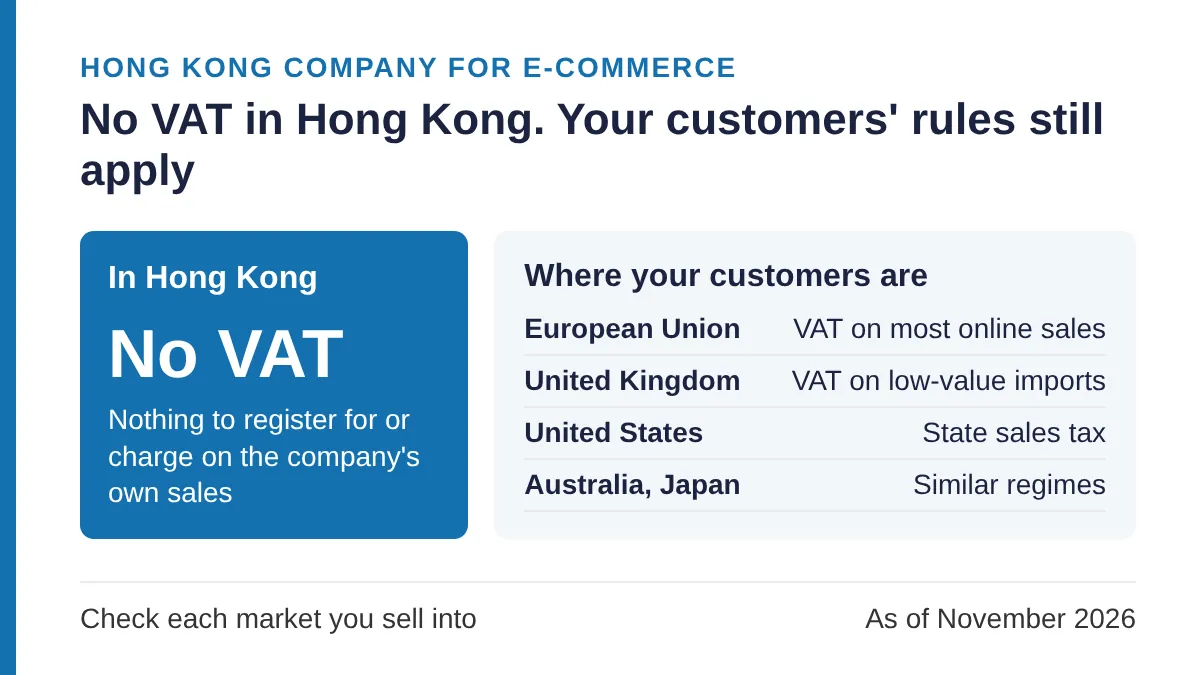
- No VAT in Hong Kong. The company does not register for or charge VAT on its own sales in Hong Kong.
- Simple company administration and no local director requirement.
- Logistics. Hong Kong is the world's busiest cargo airport, with fast air freight to most markets.
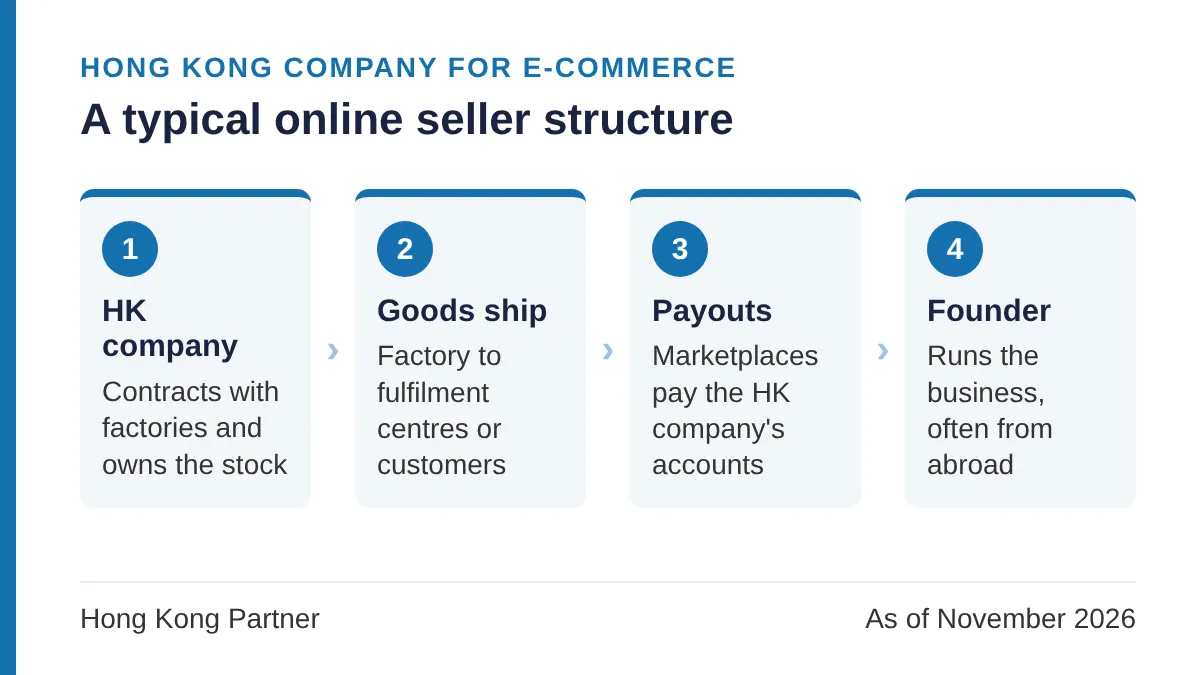
A typical structure
- Hong Kong company contracts with manufacturers, pays for inventory and owns the stock.
- Goods ship from the factory to fulfilment centres in customer markets, or directly to customers.
- Marketplaces and payment platforms pay out to the Hong Kong company's accounts.
- The founder manages the business, often from another country.
VAT and sales tax: your customers' rules apply
The most common misunderstanding is that a Hong Kong company sells "VAT-free". Hong Kong does not charge VAT, but your customers' countries may:
- The European Union applies VAT to most online sales to consumers, with special schemes for low-value imports and marketplace collection.
- The United Kingdom collects VAT on many low-value imports through marketplaces.
- US states apply sales tax rules, often collected by marketplaces.
- Australia, Japan and many other markets have similar regimes.
Marketplaces often collect and remit VAT for you, but not always, and fulfilment-centre stock can create local obligations. Check the rules for each market you sell into.
How profits are taxed in Hong Kong
Hong Kong taxes only Hong Kong-sourced profits. For e-commerce, the Inland Revenue Department looks at where the operations that generate the profit are carried out: sourcing, product decisions, marketing, pricing and customer management. The location of servers or marketplaces is not decisive.
If those operations are run from Hong Kong, profits are generally taxable at 8.25% on the first HK$2 million and 16.5% above. If they are genuinely run elsewhere, an offshore claim may be possible, but it needs evidence, and your home country may tax the profits instead. Plan this before you scale.
Banking and payments
Banks are comfortable with e-commerce companies that can show:
- Accounts with the marketplaces they sell on, and payout history if available.
- Supplier contracts or purchase orders.
- A clear description of products and target markets.
Consider how money will flow across currencies. Converting each payout to one currency and back again for supplier payments adds spread costs. Holding multiple currencies, and routing conversions to the best available rate, can make a noticeable difference to margins. See our guide to reducing cross-border payment costs.
Bookkeeping: where e-commerce gets complicated
E-commerce generates thousands of small transactions: sales, refunds, fees, advertising, shipping and currency conversions across several platforms. All of it must be recorded properly for the annual audit and profits tax return.
What helps:
- Separate accounts for the business from day one.
- Regular reconciliation of marketplace reports with bank receipts.
- Clear inventory records for cost of goods sold.
- An accountant who understands marketplace reports.
Our accounting service is set up for exactly this kind of high-volume, multi-currency business, so the year-end audit is a formality rather than a scramble.
Frequently asked questions
Can a Hong Kong company sell on major online marketplaces?
Generally yes. Major marketplaces and payment platforms accept Hong Kong-registered sellers, subject to their own verification requirements.
Do I pay VAT in Hong Kong on online sales?
No. Hong Kong has no VAT or sales tax. However, the countries where your customers are located may charge VAT, GST or sales tax, and marketplaces often collect it.
How are e-commerce profits taxed in Hong Kong?
Under the territorial principle, profits are taxed in Hong Kong if they arise from business operations carried on in Hong Kong. The Inland Revenue Department looks at where the operations that generate the profit take place.
Sources
This article is general information, not legal or tax advice. Rules and figures can change; confirm details for your situation before acting.